First, the system gets to know your company. Then every article takes the same route.
At the start, you set up what your company and its experts know, once. After that, every article goes through the same steps, from topic to posts. Once it’s published, you see how it performs. For each step we spell out what the system does and what you decide.
The screens on this page are app views recreated with data from Klaro, a fictional company.
You set up your company knowledge once. Every article after that draws on it.
In a chatbot, you paste in your company description every time. Here you do it once, at the start. You can change anything later.
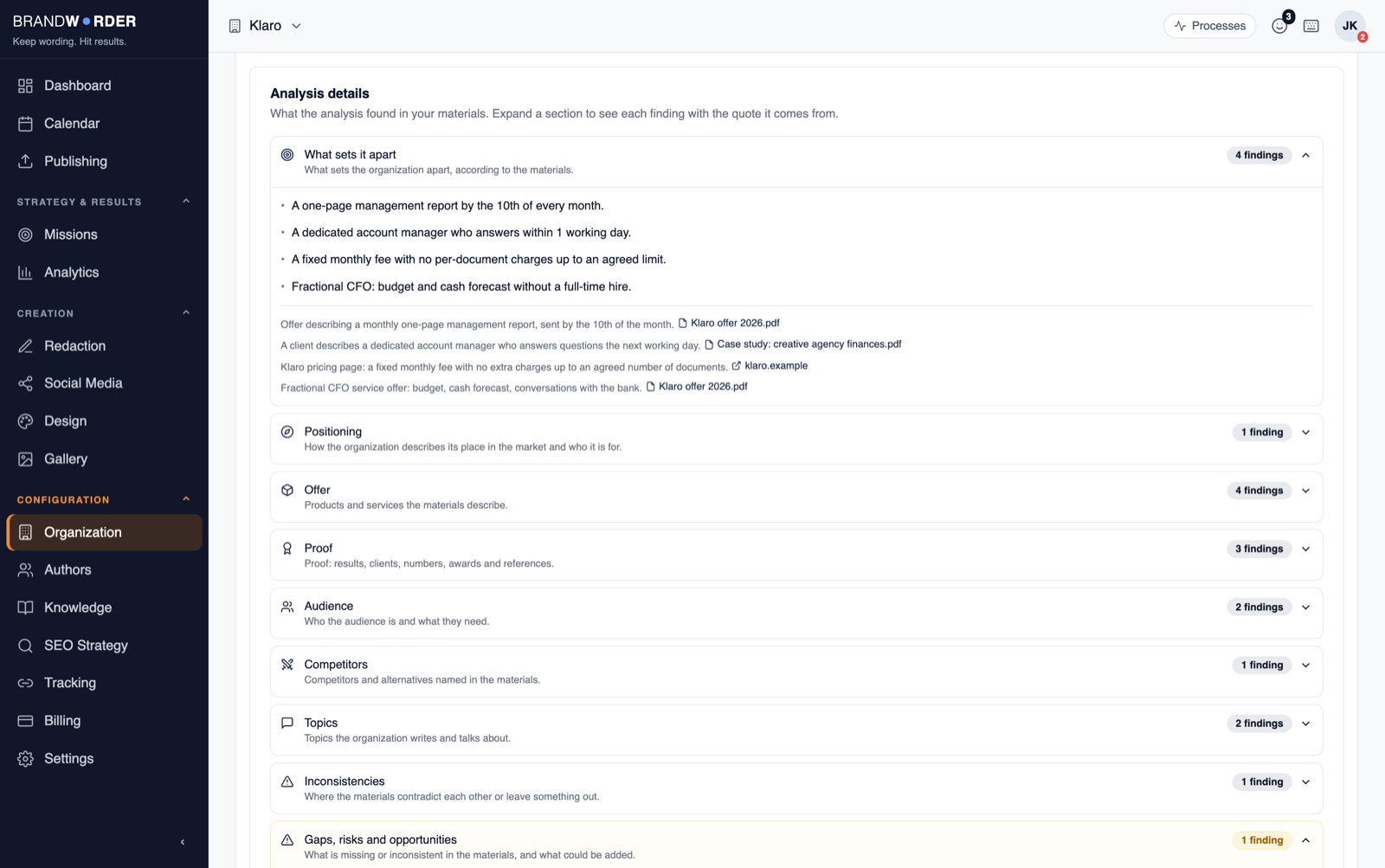
It reads your company’s materials and pulls out what sets you apart
Brandworder Reads your website and the materials you upload. Pulls out what sets you apart, your positioning, what you sell, proof, competitors and topics. Every finding comes with a quote and the file or page it came from. It flags inconsistencies and gaps, such as a claimed strength with no proof behind it.
You For each field you pick the version that stays: your own declaration, what was found in the materials, or text you write yourself.
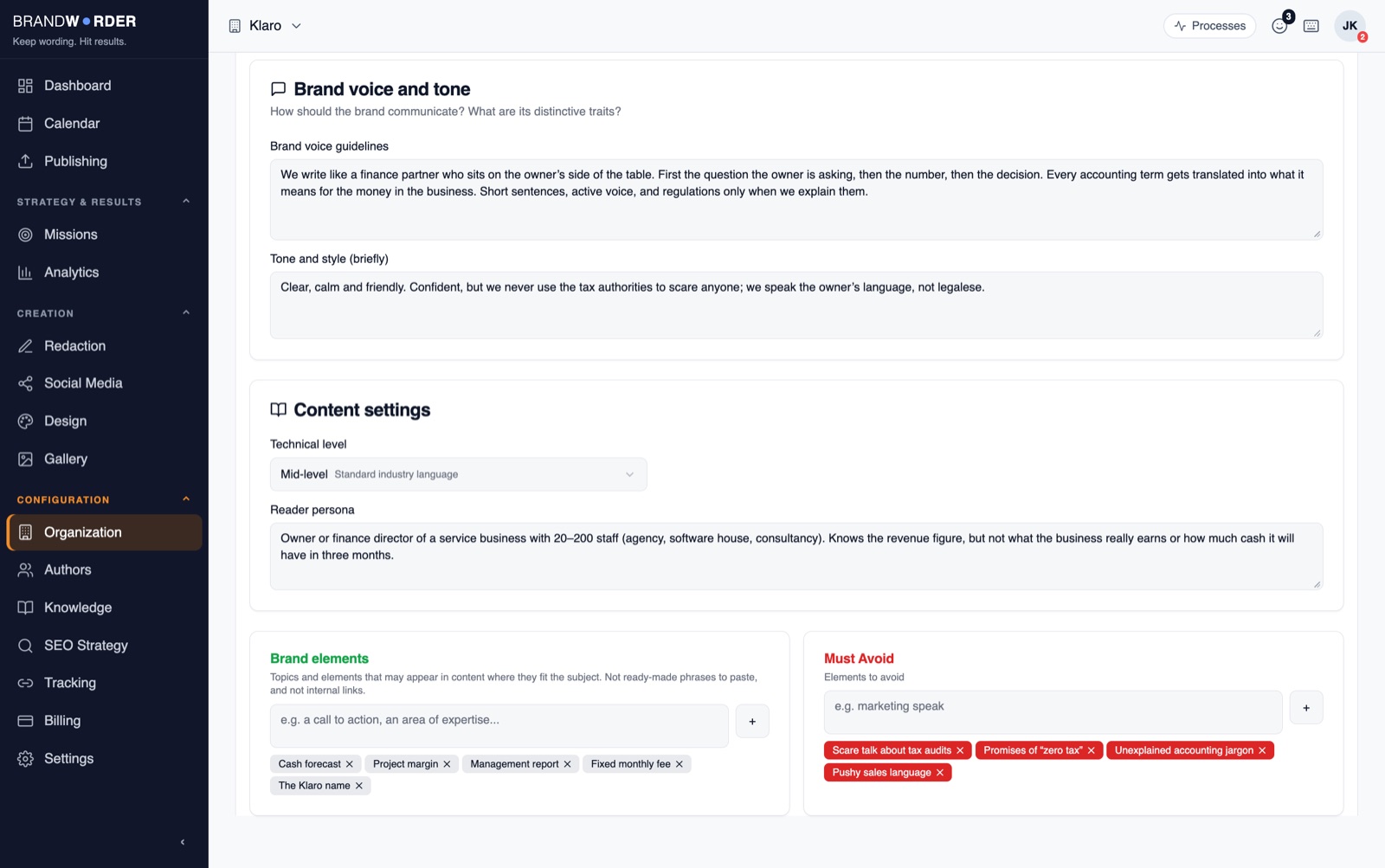
Brand Voice: how your company writes
Brandworder Stores your voice guidelines, tone and style, how technical the writing should be, who the reader is, the brand’s own vocabulary and the words it avoids.
You You can edit every field. Every article draws on this description, whoever writes it.
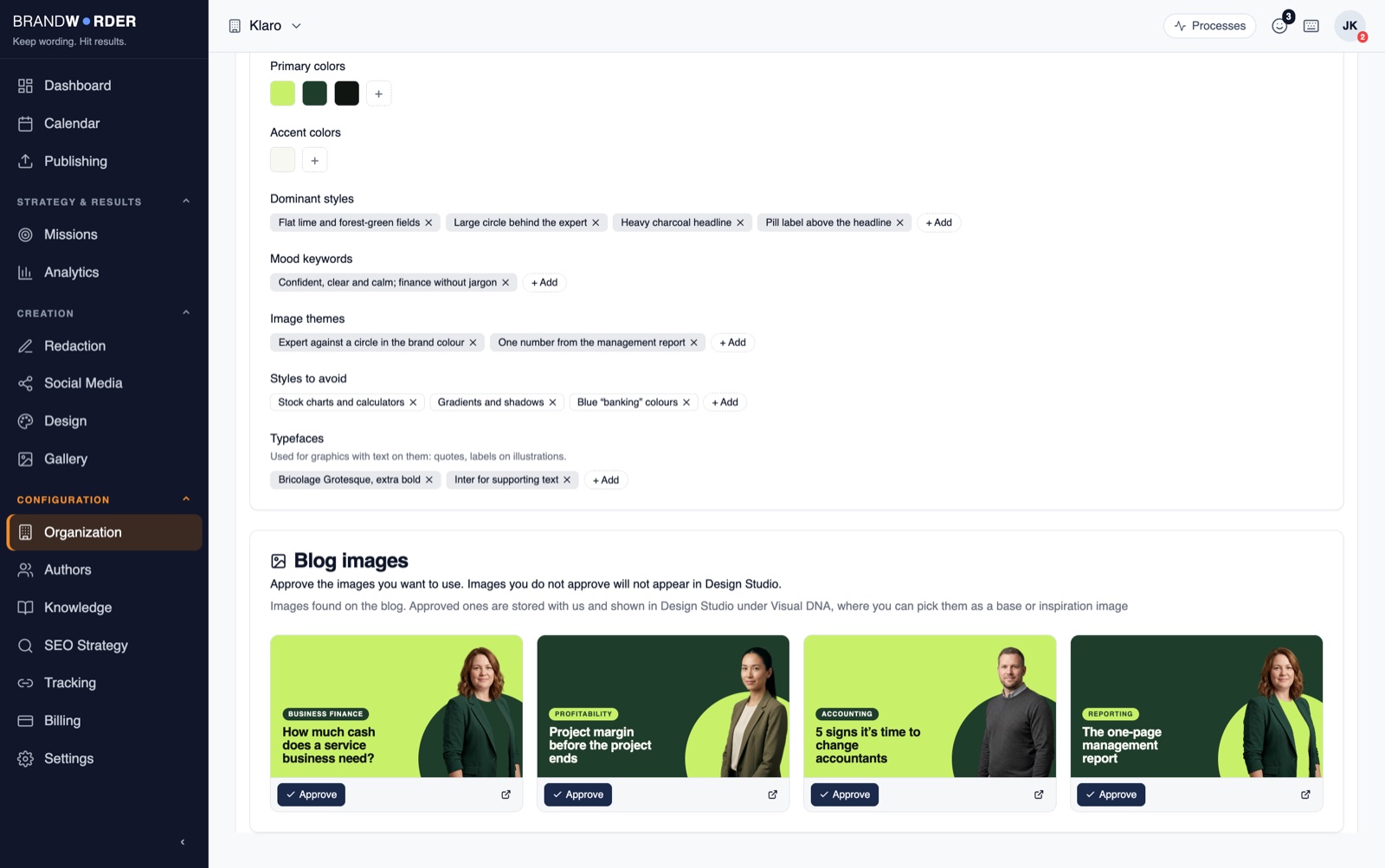
Visual DNA: what your company’s graphics look like
Brandworder Goes through the images on your company blog. Notes the colours, dominant styles, mood, and the styles your brand stays away from.
You You approve the images that should serve as references. They go into Design Studio. You can add or remove style traits.
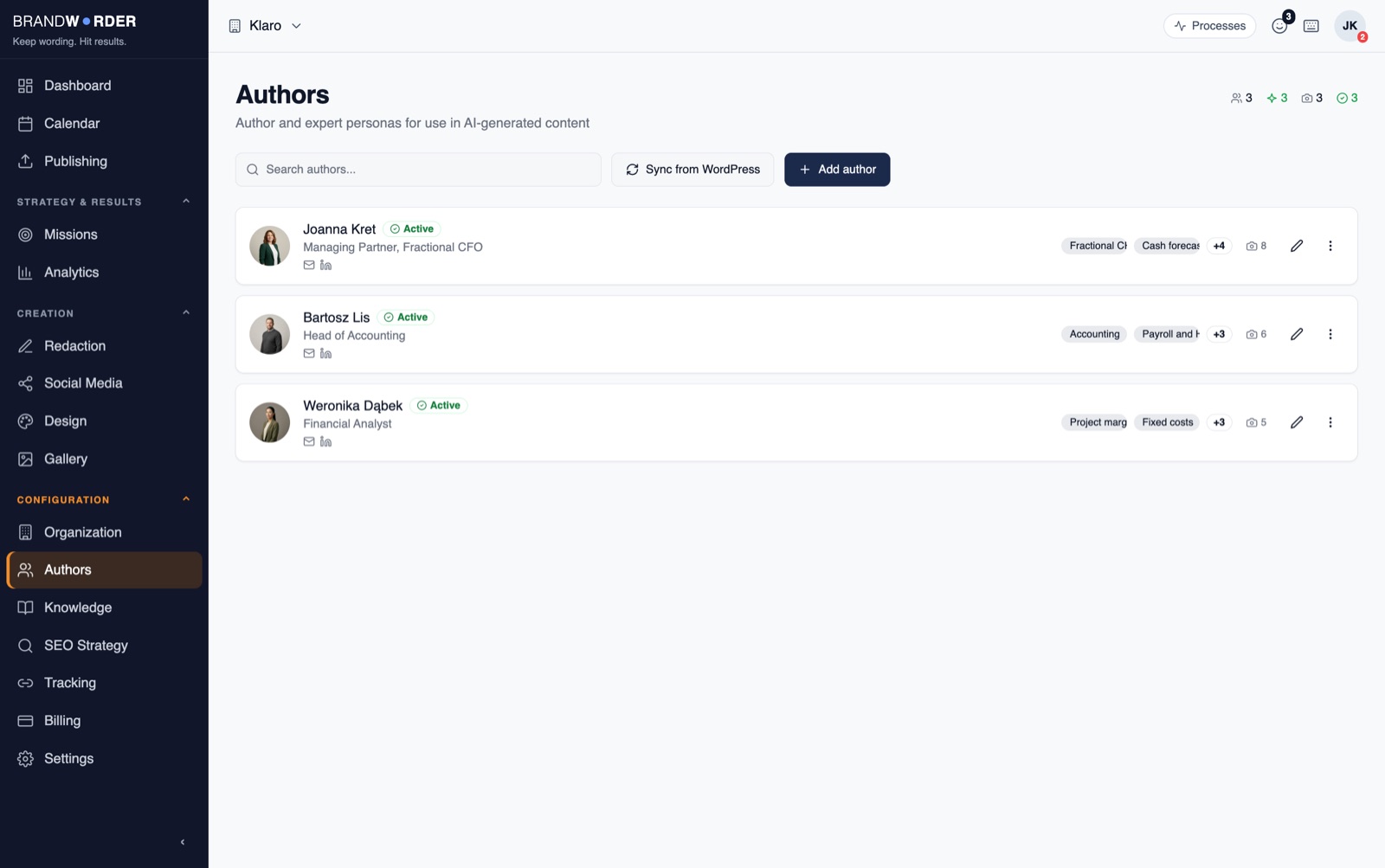
Every expert has a profile
Brandworder The Authors module keeps all your company’s experts in one place: role, specialisations and photos for graphics.
You You add your experts and assign each article to a named person. The article goes out under their name.
The number of experts depends on the plan: Creator 1, Publisher 2, Business unlimited.
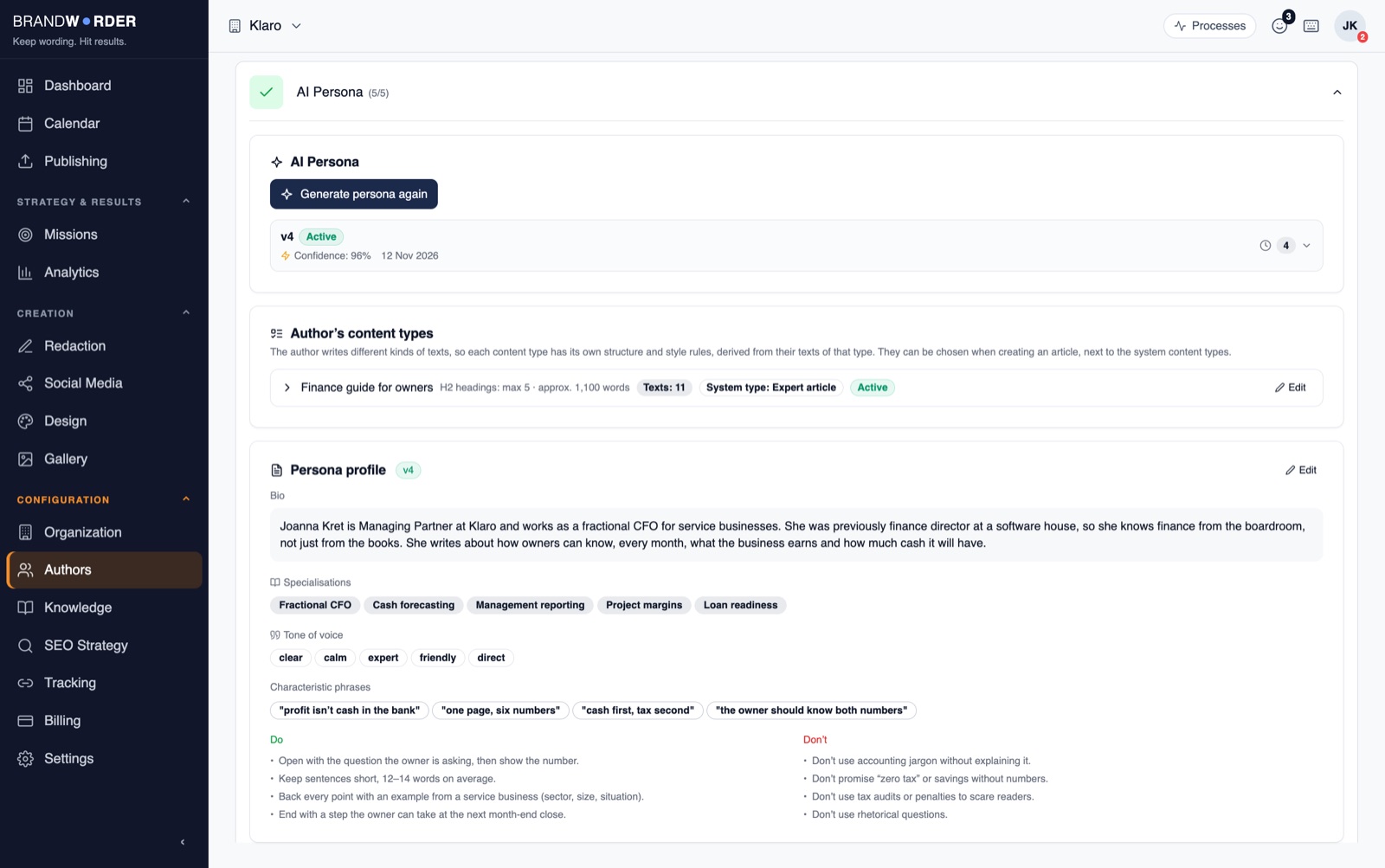
It sounds like your expert, not like a chatbot
Brandworder Builds a profile from articles the expert has already written: bio, specialisations, tone of voice, characteristic phrases and Do / Don’t rules.
You You choose the articles to learn from. You can edit the profile.
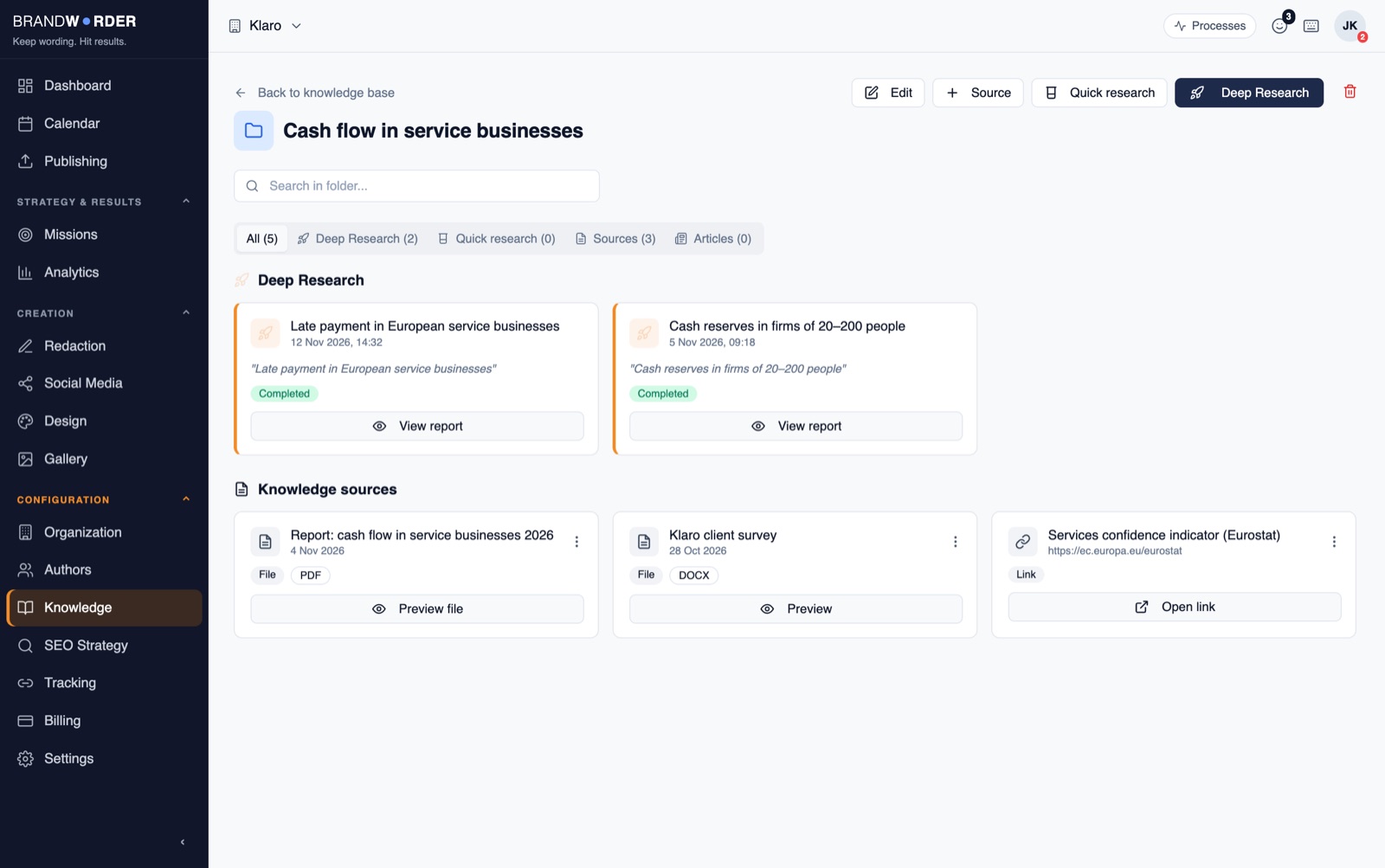
Knowledge you won’t find online
Brandworder Stores your sources: documents, research, notes and links, including things you won’t find online. It can research a topic on its own, with cited sources, and add the results to the knowledge base.
You You upload materials and sort them into folders. For each article you choose which folders it can use.
You do this once. Every article then starts with that knowledge.
Every article takes the same route. You stop wherever you want.
From the campaign goal to the posts. The steps always run in the same order, so nothing gets dropped. Campaigns come with the Business plan; publishing and posts with Publisher and up.
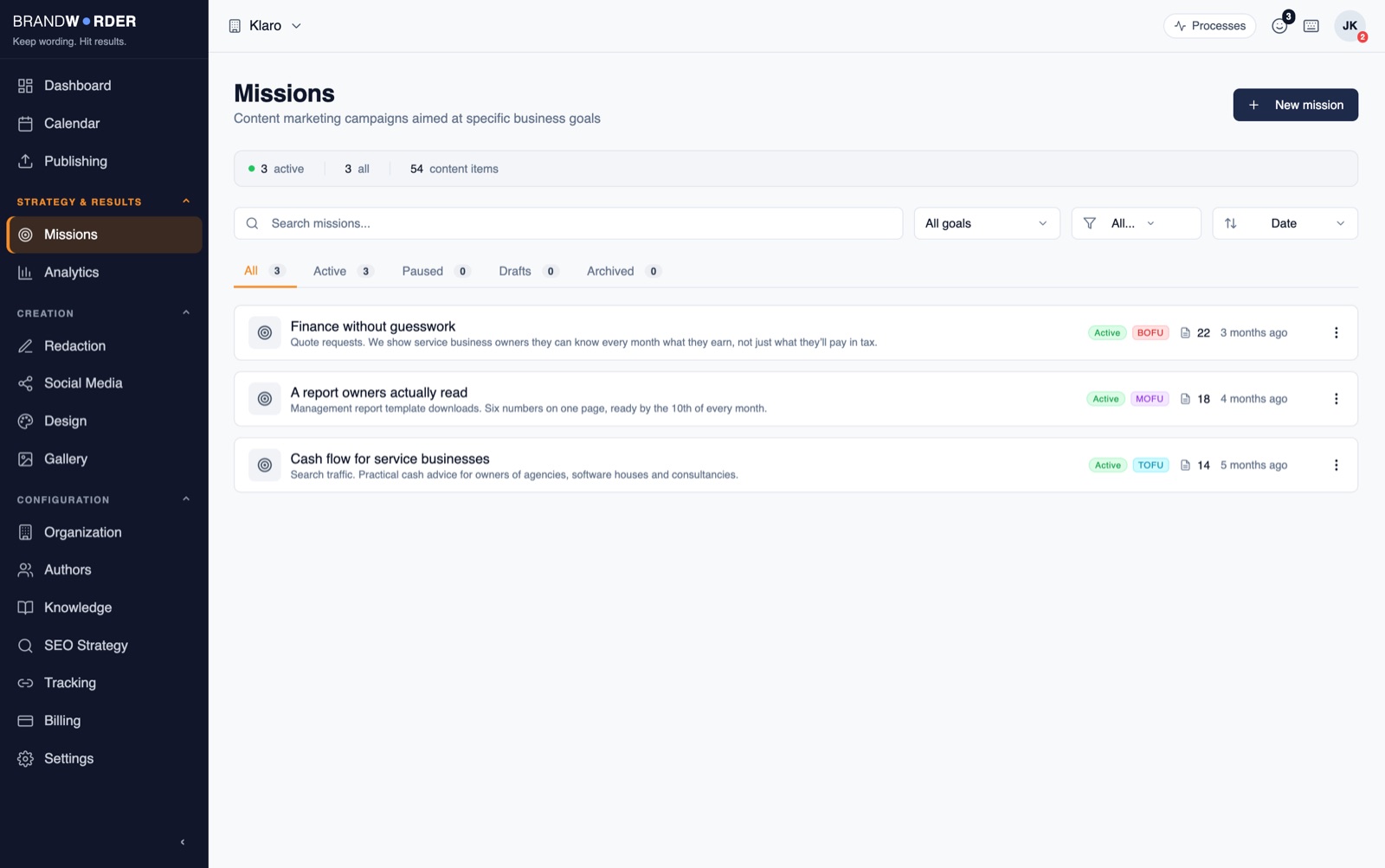
A campaign with a business goal
Brandworder Groups content into campaigns, each with a goal, a buying-journey stage and an audience. Shows how much content each one has produced and which are active. In the app, a campaign is called a Mission.
You You set the campaign goal.
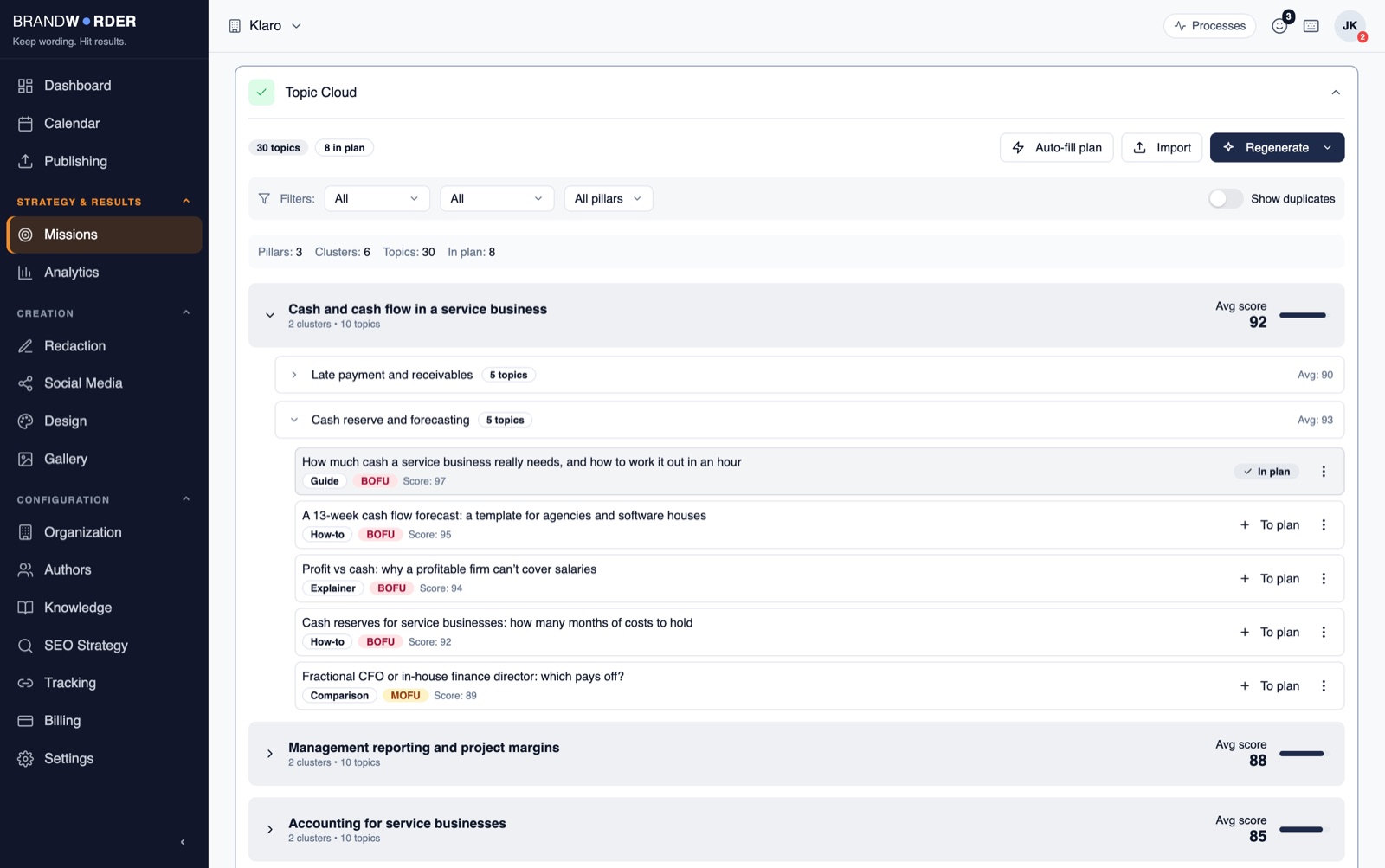
Topics that serve the campaign goal (Topic Cloud in the app)
Brandworder Suggests topics for the campaign goal, grouped into pillars and clusters. Each topic has a score, a format and a funnel stage.
You You pick the topics and add them to the plan in one click.
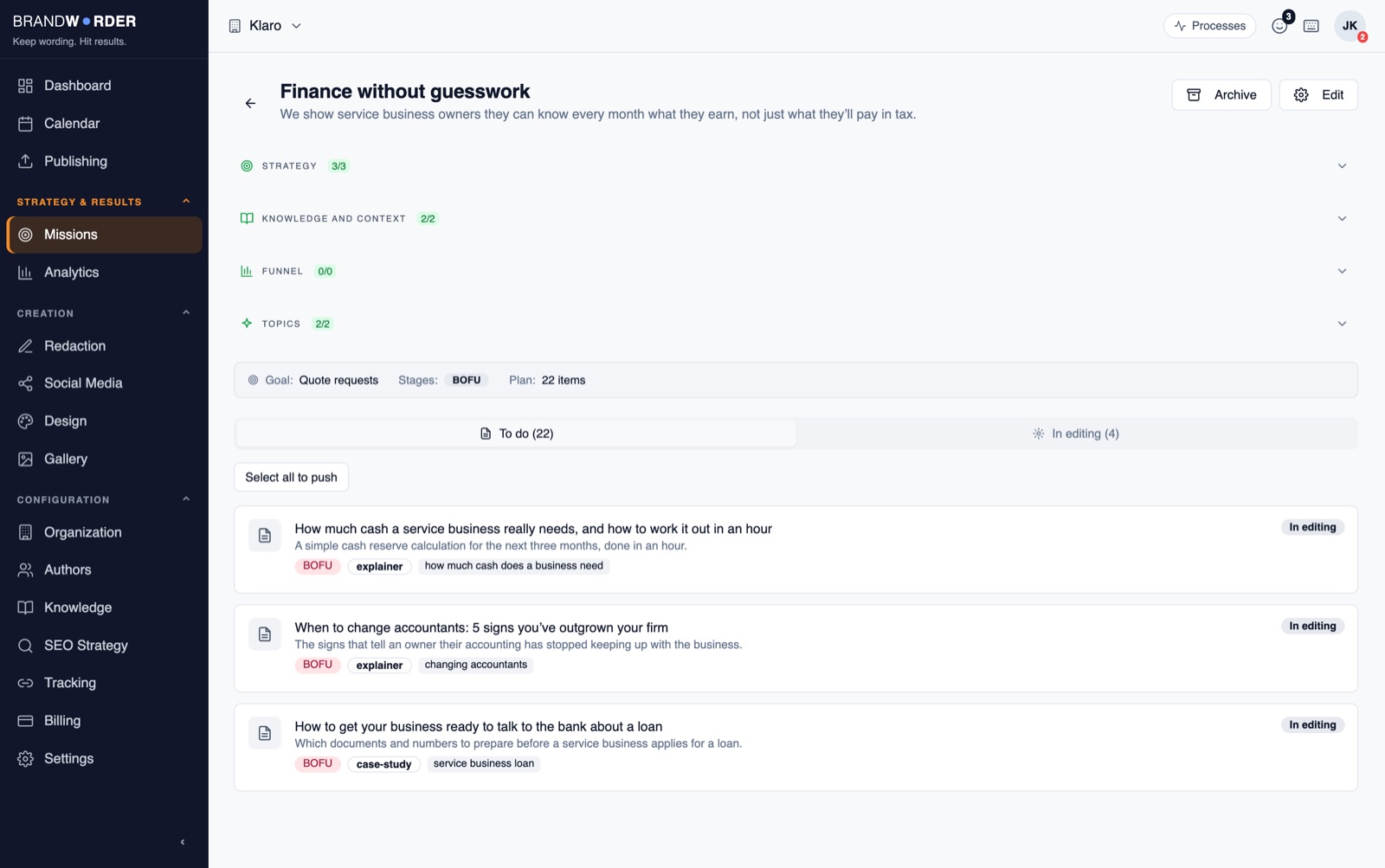
From the plan straight into the article workflow
Brandworder Builds a plan of topics to write. Every topic has a description, a format and a target keyword. From the plan, a topic goes into the article workflow as a ready-made brief.
You You decide which topic goes into the article workflow.
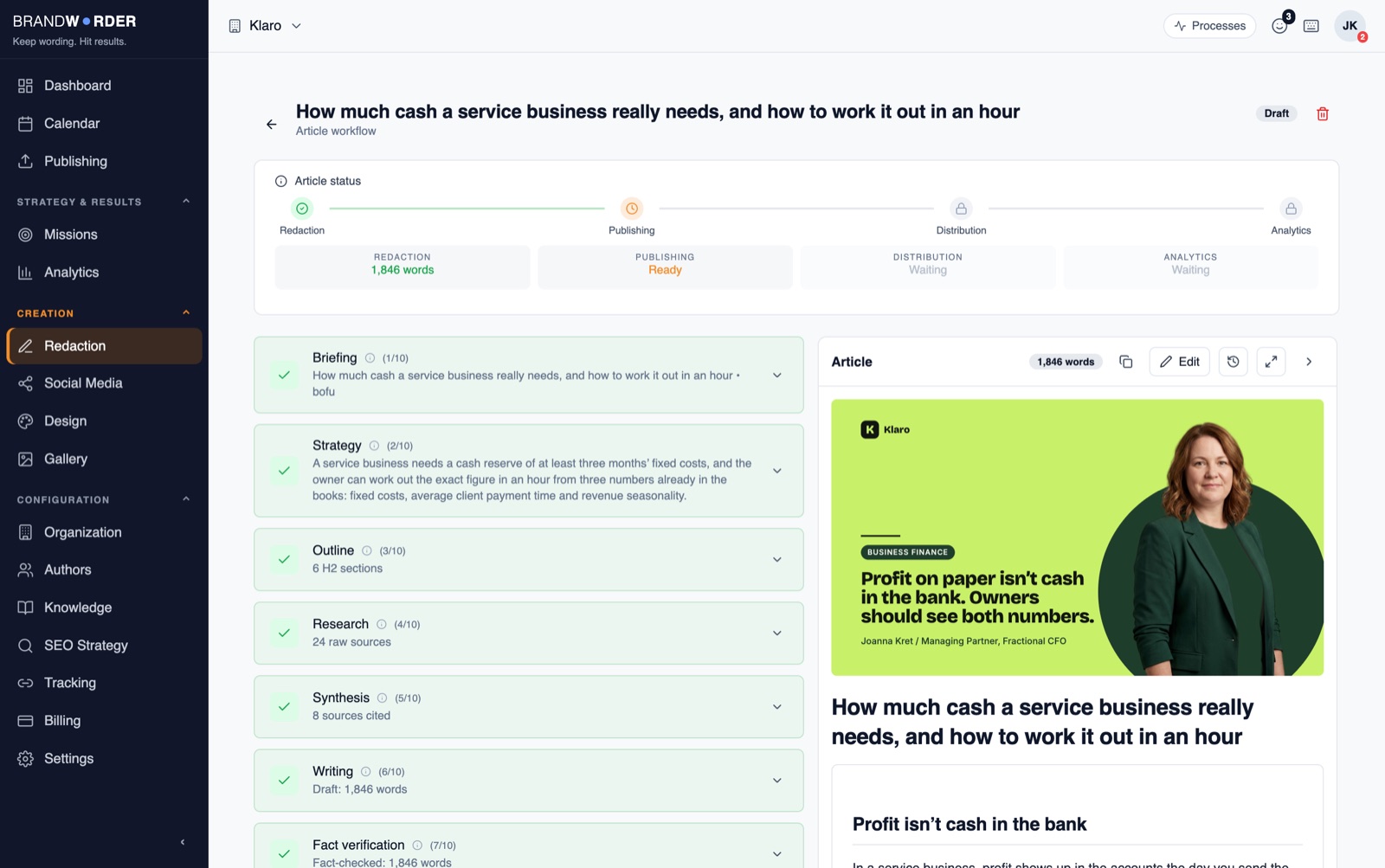
The workflow steps, always in the same order
Brandworder Takes the article through 11 steps in turn: Topic, Requirements, Format, Strategy, Outline, Research, Draft, Fact-check, SEO, Images and CMS. The status bar at the top shows Redaction (the app’s name for this stage), Publishing, Distribution and Analytics.
You You see what stage the article is at. You only open the step you want to change, and leave the rest alone.
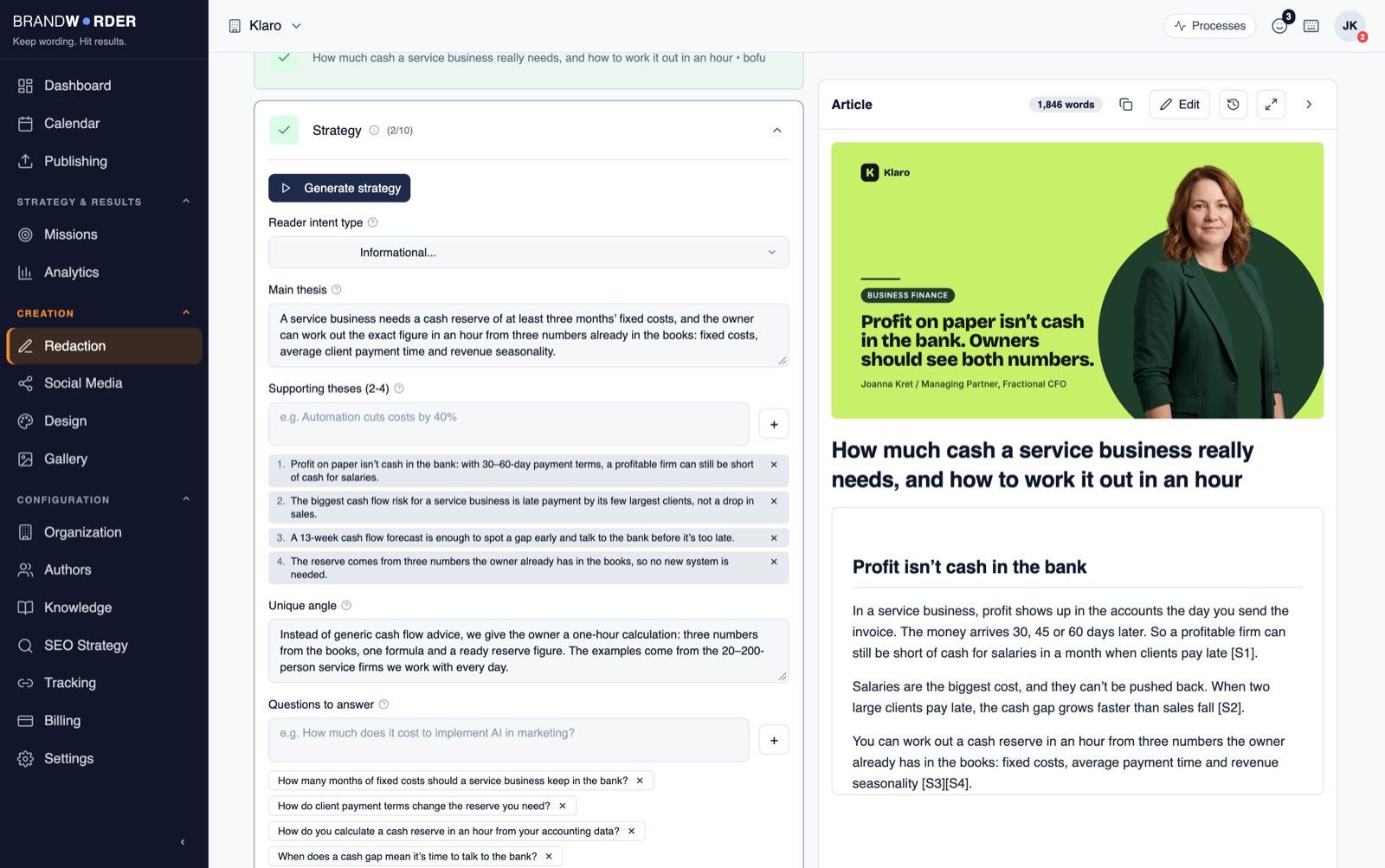
Thesis and plan first, then the writing
Brandworder Works out what the reader is looking for and sets the main thesis. Adds supporting theses and the questions the article will answer. Then builds an outline with headings.
You You adjust the thesis and the plan before a single sentence is written. That’s quicker than rewriting a finished draft.
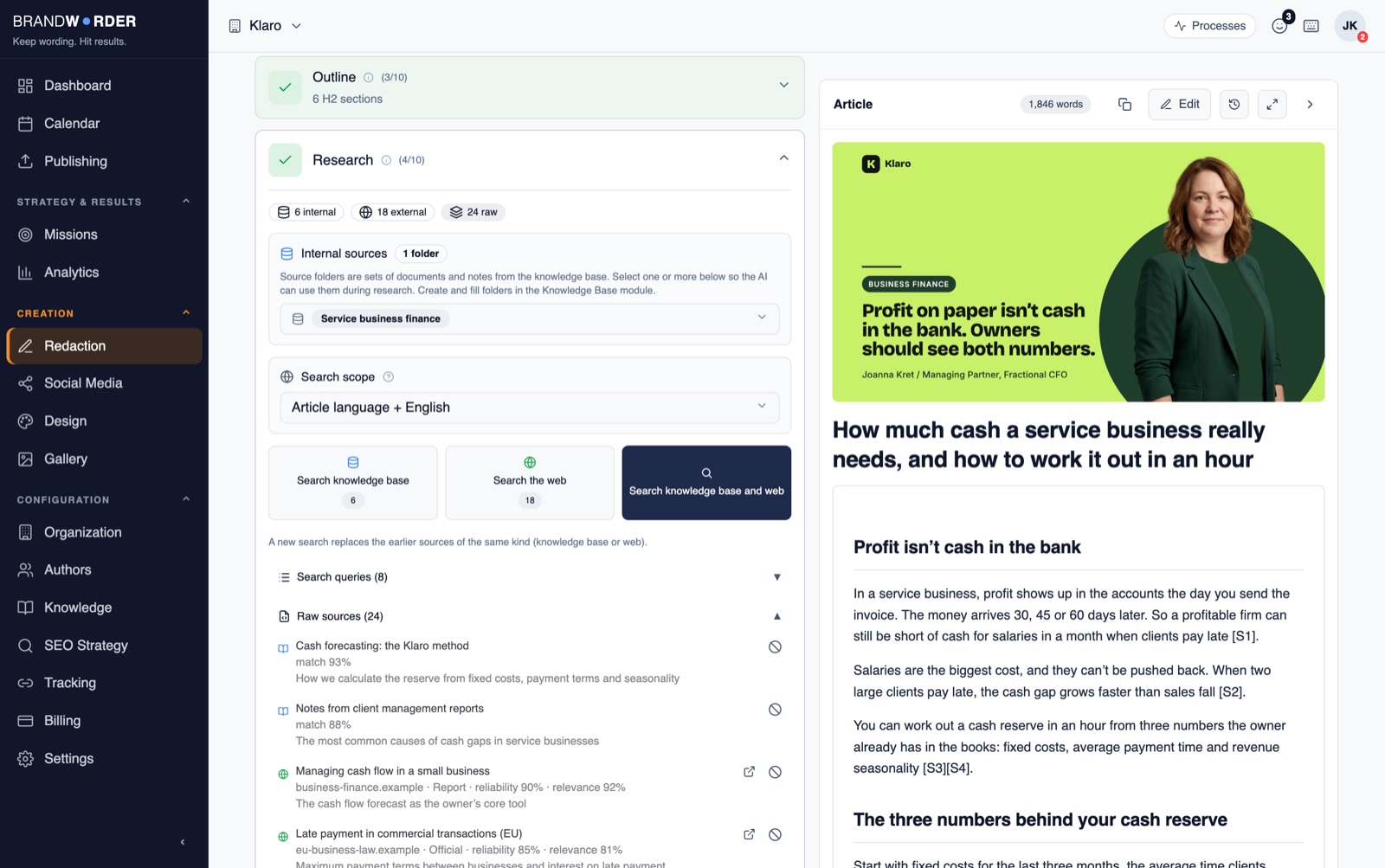
You see which sources the article is built on
Brandworder Searches your company’s knowledge base and the web. Web sources are scored for reliability and relevance. The system pulls the findings together, with links back to the sources.
You You choose the knowledge base folders and exclude sources you don’t trust.
A draft in your expert’s voice
Brandworder Writes the draft in the assigned expert’s voice, following the approved plan and sources.
You You change only what you want to change.
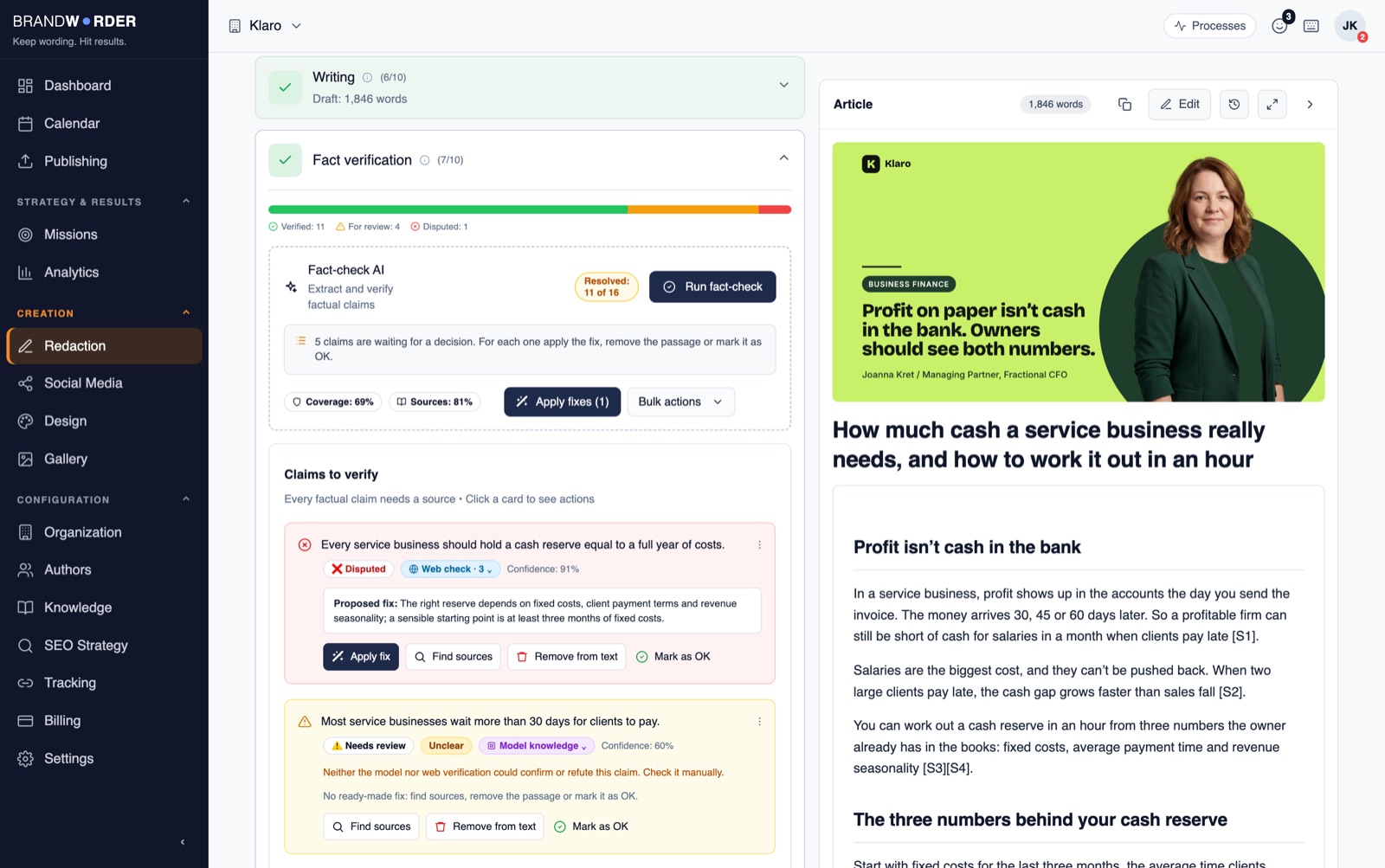
Claims pulled out of the text, each one checked separately
Brandworder Pulls the claims out of the text and checks each one separately. For each one it shows the result, the confidence level and how it was checked: against a source, on the web or from the model’s knowledge. For a disputed claim it proposes a fix. If it can’t confirm a claim, it says so: check it manually.
You You settle anything in doubt yourself. You have four options: apply the fix, find sources, remove it from the text or mark it as OK.
The system checks the claims it has extracted. We don’t promise it will catch every one. That’s why the final say belongs to the expert whose name goes on the article.
Ready for search engines
Brandworder Prepares the article for search engines.
You If there’s nothing you want to change, you move on.
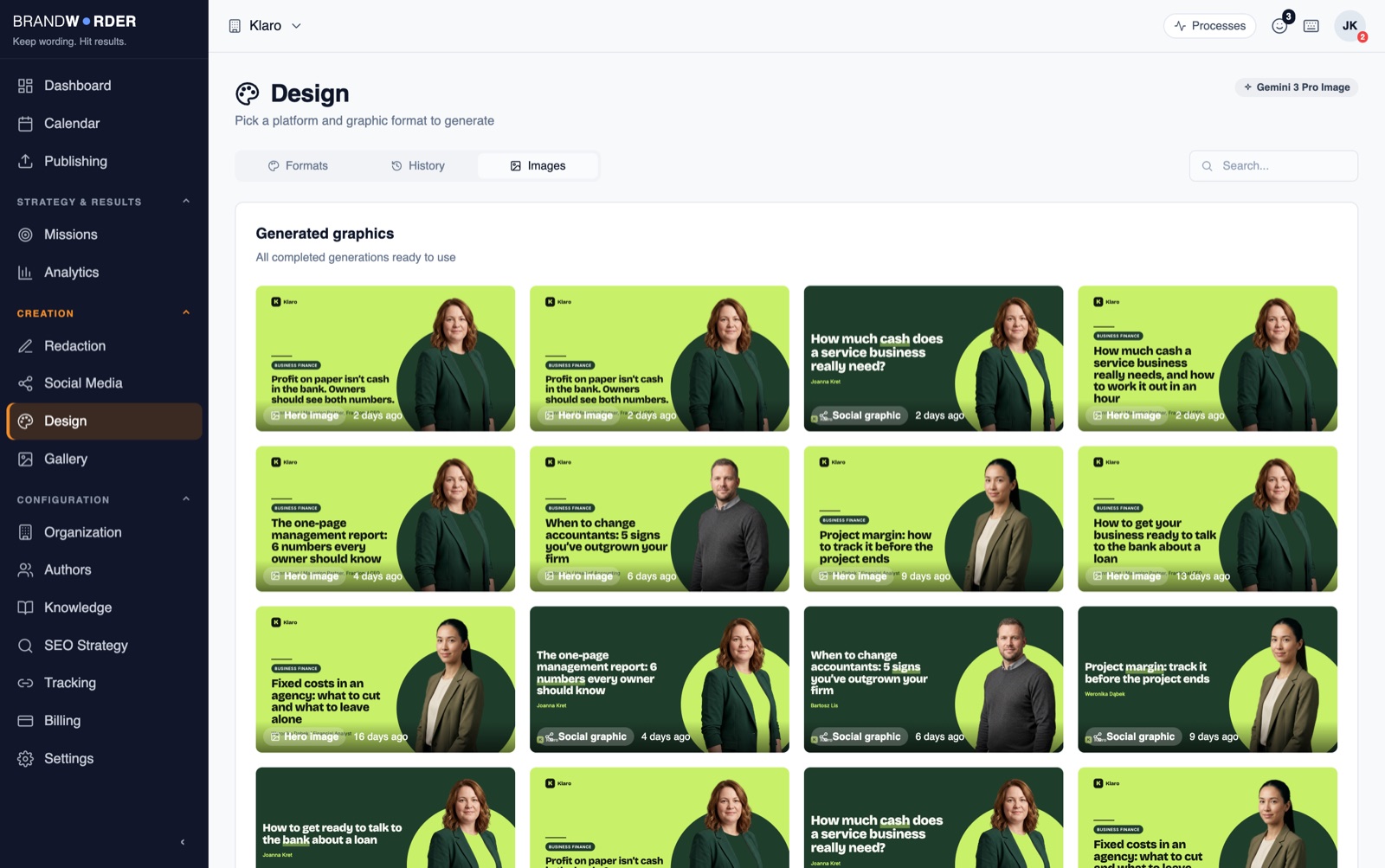
Design Studio: graphics in your brand colours
Brandworder Creates the article’s hero image and graphics for posts. Takes the colours and style from your Visual DNA. The graphic can feature the expert and a quote from the article.
You You choose the platform and the graphic format. For a post you can also pick a saved graphic or upload your own.
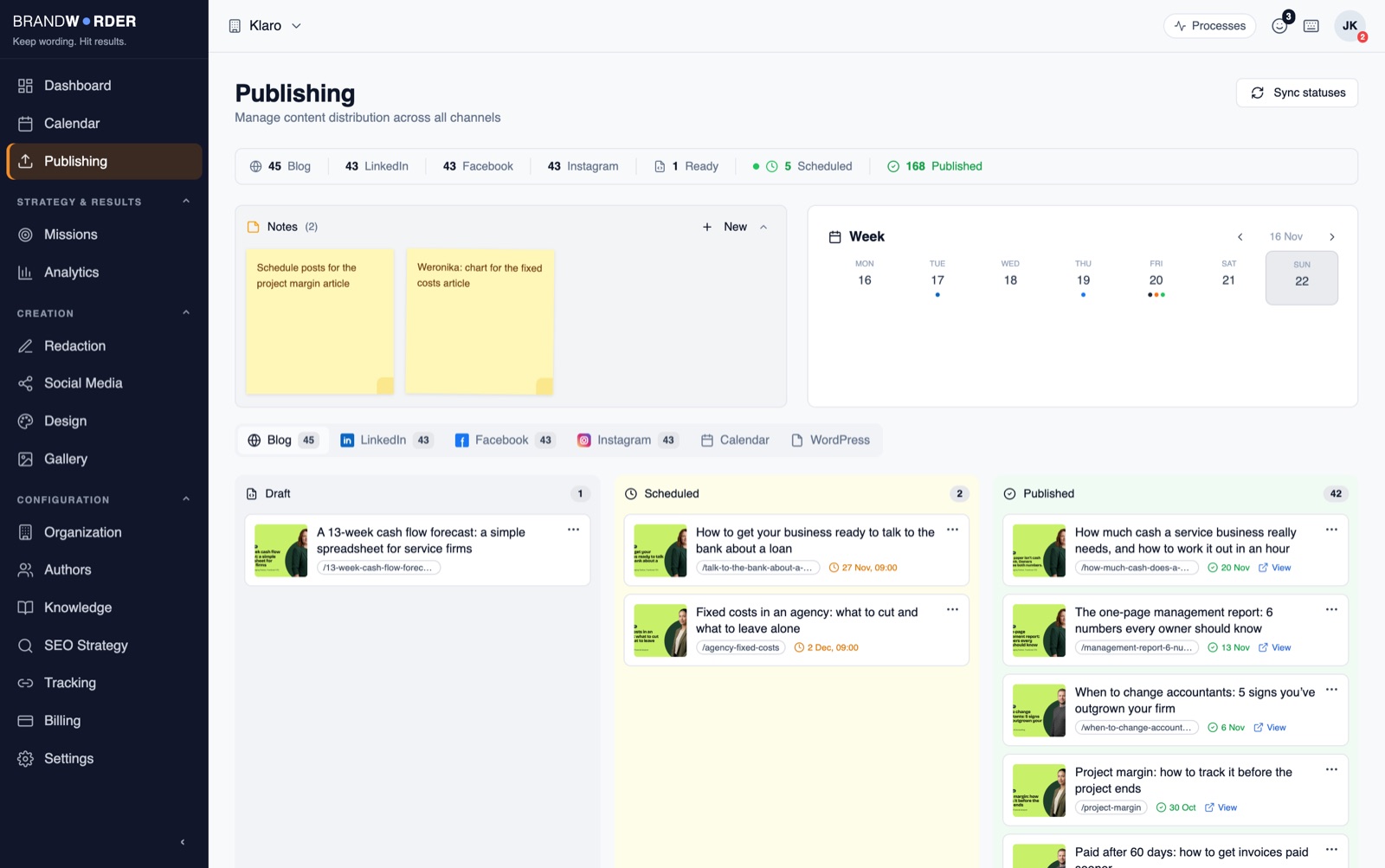
Publishing on your company website
Brandworder Publishes the article on your company website if it runs on WordPress. Drafts, scheduled and published articles sit on one board. You see articles and posts in one calendar.
You You choose the publication date.
On the Creator plan you download the article as a PDF or a document and publish it yourself.
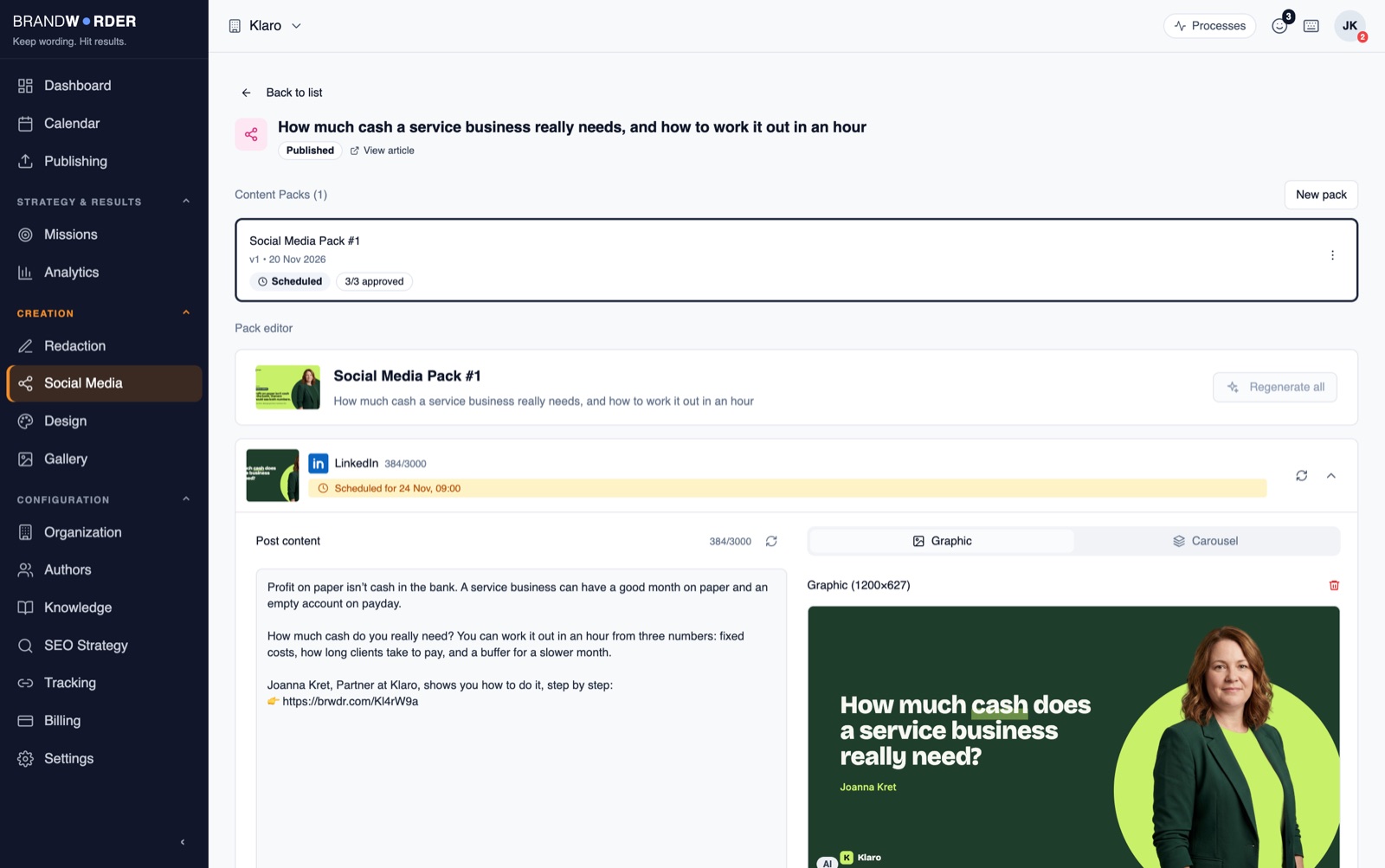
Social Pack: posts from every article
Brandworder Turns the article into posts for LinkedIn, Facebook and Instagram, each with a graphic, plus a carousel for LinkedIn. Every post carries a short link to the article on your website. You schedule and publish the posts from the app.
You You approve each post separately. You can change the text and the graphic.
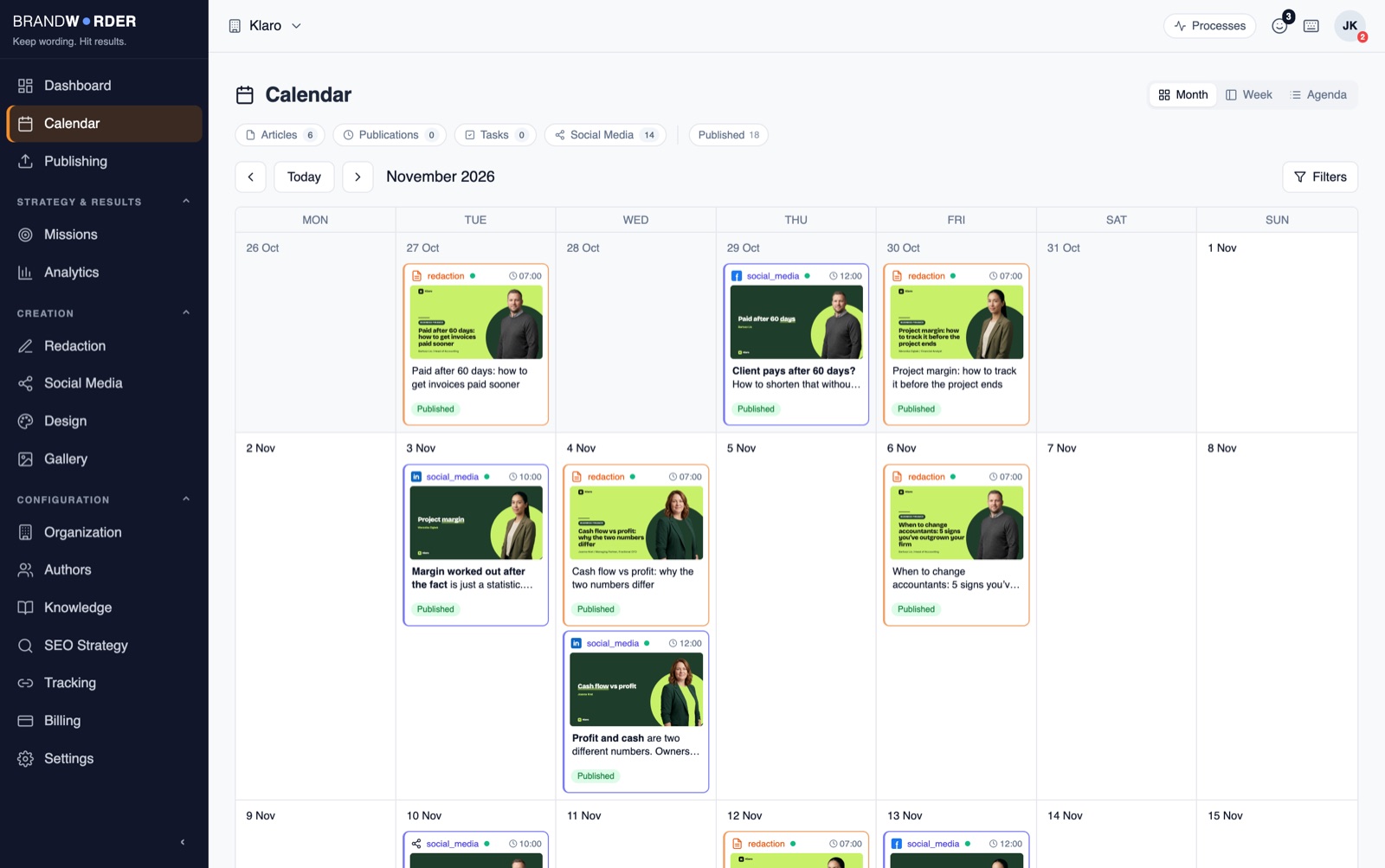
Articles and posts in one calendar
Brandworder Shows all your articles and posts on one timeline, in month, week or list view. You see at a glance what’s gone out and what’s still waiting.
You You set the date for every item yourself.
The calendar comes with every plan.
The system never publishes on its own. Your expert has the final say.
What do you see after publishing? Each campaign’s funnel.
Search visibility data comes from Google Search Console. Every campaign gets its own report.
- Exposure, clicks, visits and engagement, from top to bottom.
- You get the same numbers for every campaign and every article.
- The system points out where the funnel narrows.
An enquiry counts as a goal once you tag the form on your website. That way you see the path from first view to enquiry. What happens next stays in your CRM, because there’s no CRM integration.
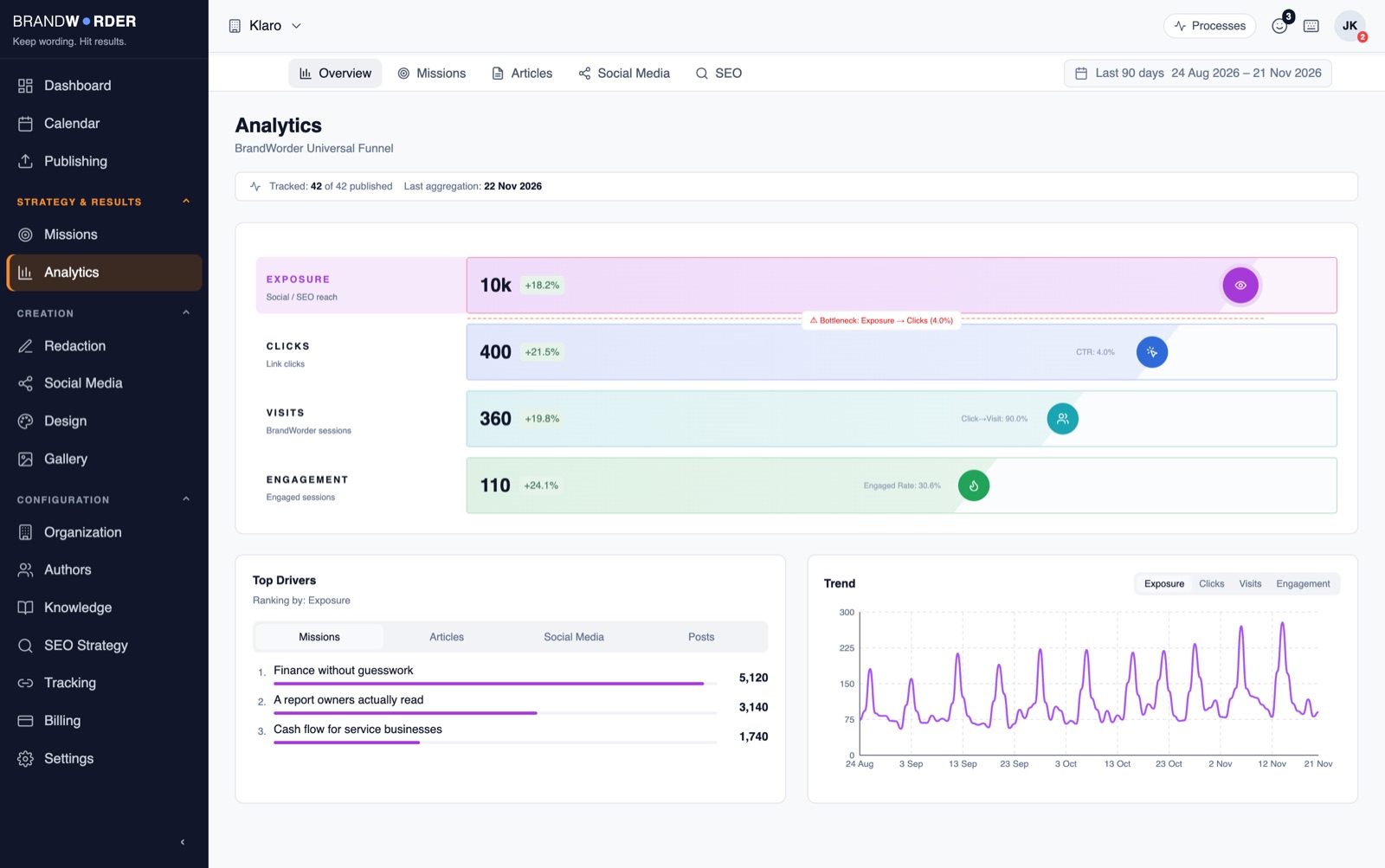
- The system flags the bottleneck for you: here, between exposure and clicks.
- How many articles are tracked, and when the data was last pulled.
- Campaigns, articles and posts ranked by results.
20 minutes. That’s how long the system spends on an article, including finding sources.
You read, edit and decide. We don’t quote a figure for this, because it depends on the topic and the expert. We’ll measure it on your first article, in minutes.
Initial setup takes one to two working days. A full rollout with your team takes up to two weeks. We’ll help you get set up.
The steps every article goes through
- Topic
- Requirements
- Format
- Strategy
- Outline
- Research
- Draft
- Fact-check
- SEO
- Images
- CMS
That’s the process. Let’s talk about how it would look at your company.
We’ll walk you through the system with a worked example and match the plan to the way your company works.