One article, taken apart.
Klaro is a fictional demo company: accountants and outsourced finance for service businesses. The article “How much cash a service business really needs, and how to work it out in an hour” goes out under the name of its expert, Joanna Kret. We show you what went into it, and what a human decided along the way.
The company, the expert and the data are fictional. The app views are recreated with that data.
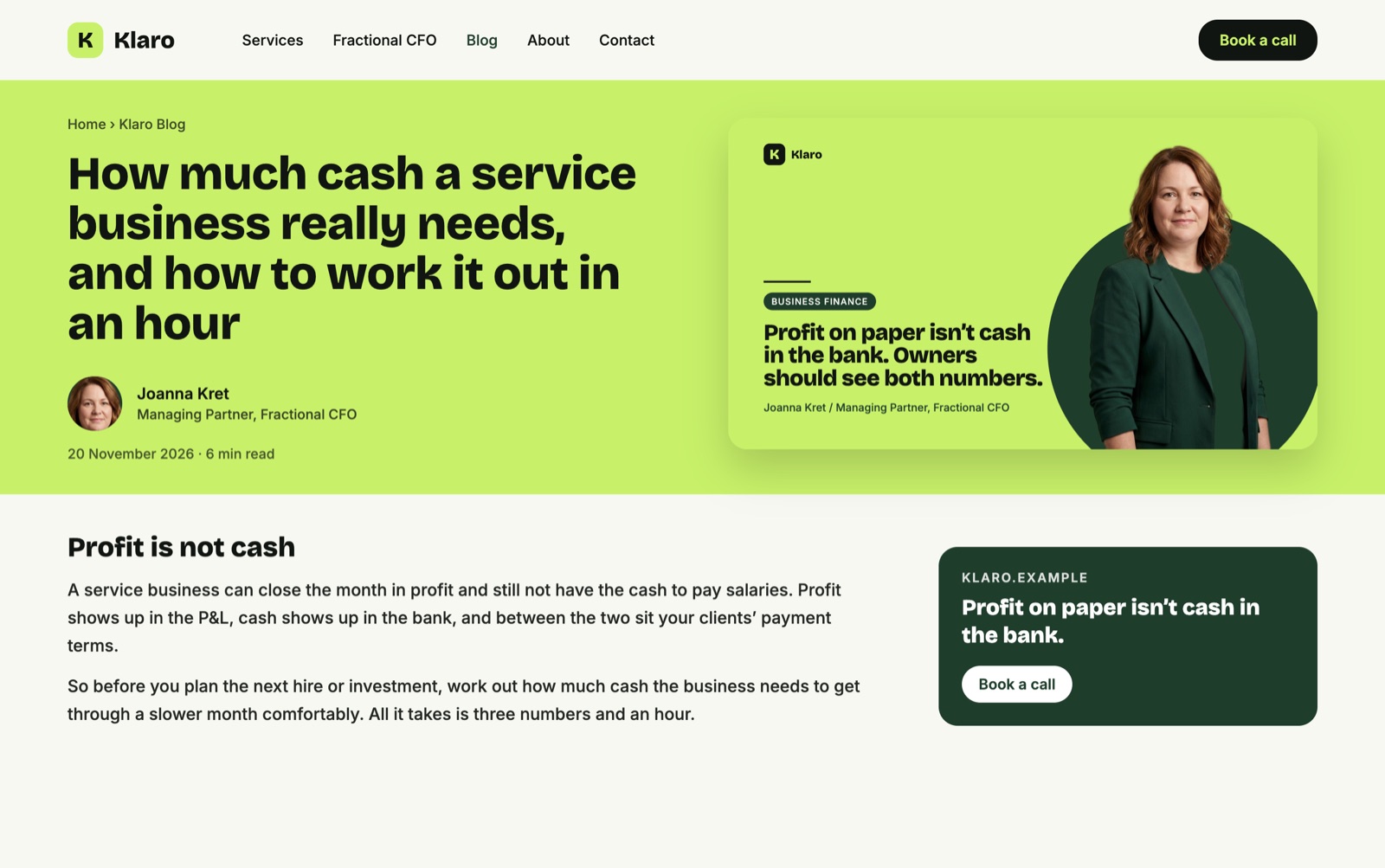
This is what the reader sees. On the company blog, under the expert’s name.
- The article sits on Klaro’s blog, on the company’s own domain.
- Byline: Joanna Kret, Managing Partner, Fractional CFO. Published 20 November 2026, 6 min read.
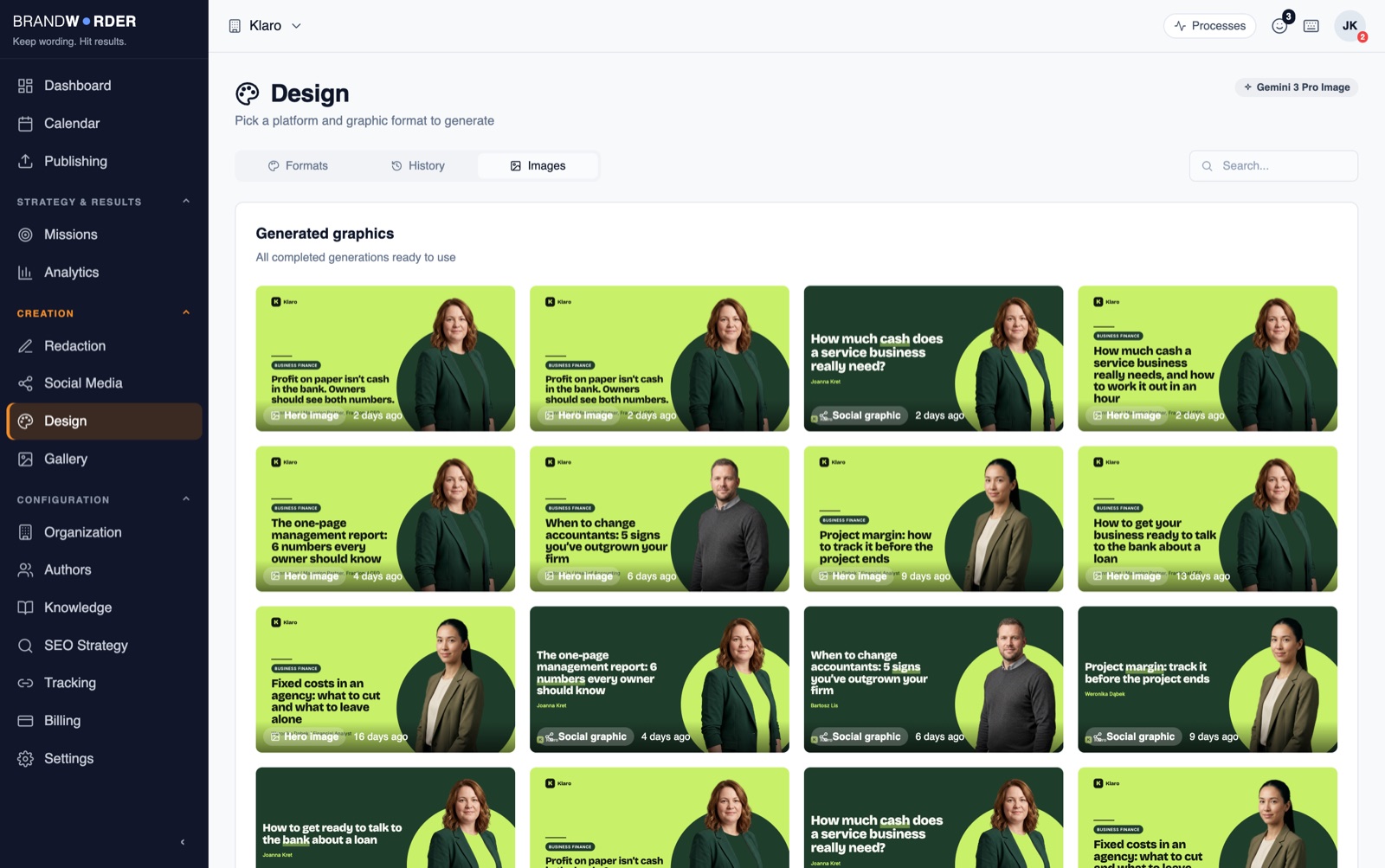
- The hero image is in the brand colours, with the expert’s photo and a quote: “Profit on paper isn’t cash in the bank. Owners should see both numbers.”
- The page header carries Klaro’s own button: “Book a call”.
A service business can close the month in profit and still not have the cash to pay salaries.
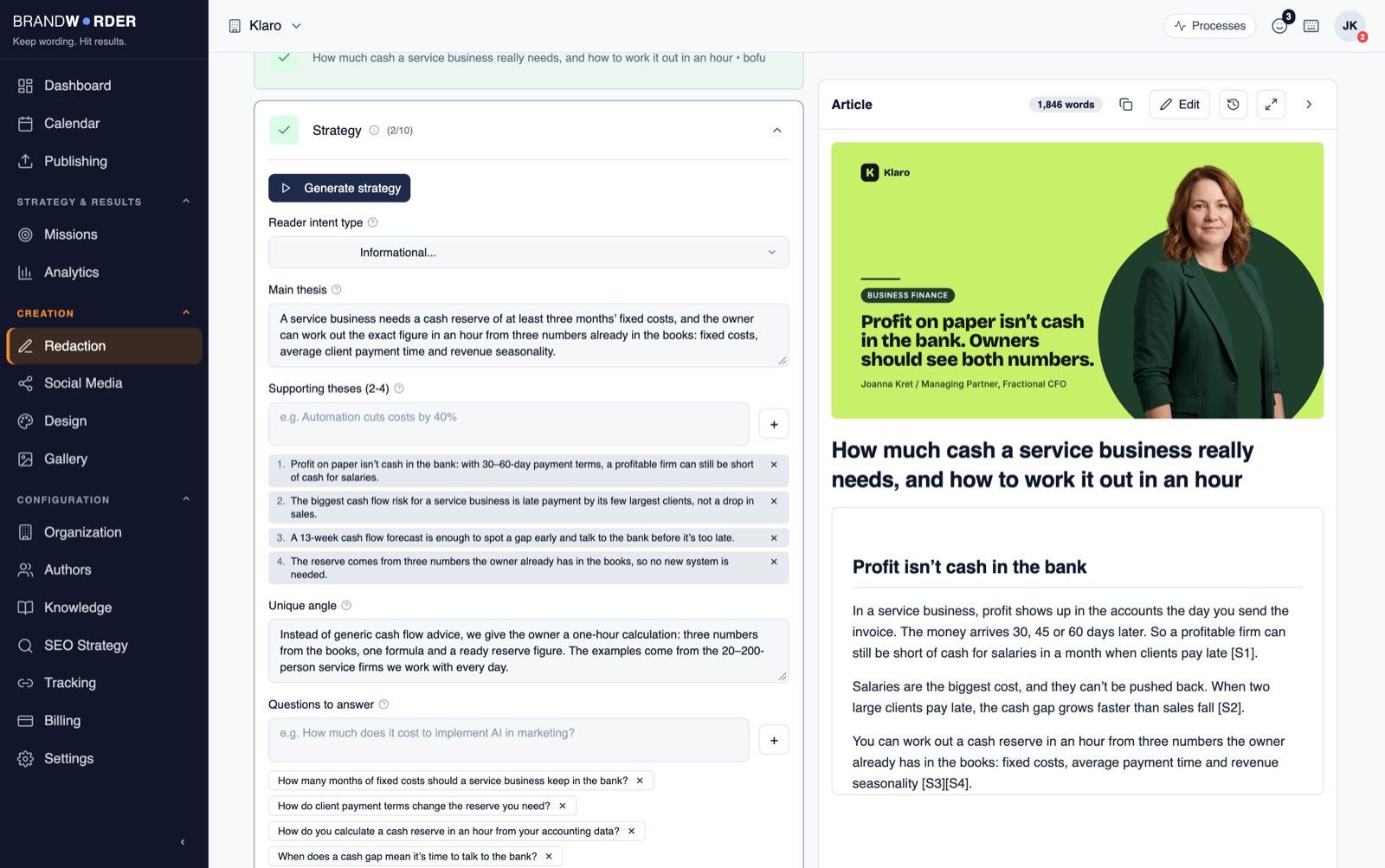
Before the first sentence was written, there was a thesis and a plan.
- What the reader is looking for: an answer to a question (in the app: informational intent).
- Main thesis: a service business needs a cash reserve of at least three months’ fixed costs, and the owner can work out the exact figure in an hour from three numbers already in the books.
- Four supporting theses, including: the biggest cash flow risk for a service business is late payment by its few largest clients, not a drop in sales.
- Four questions the article has to answer, such as how many months of fixed costs a service business should keep in the bank, and when a cash gap means it’s time to talk to the bank.
- Outline: six sections, from “Profit isn’t cash in the bank” to “When a cash gap means it’s time to talk to the bank”.
Where a human decides The thesis and the plan can be edited, reordered or trimmed before the system starts writing.
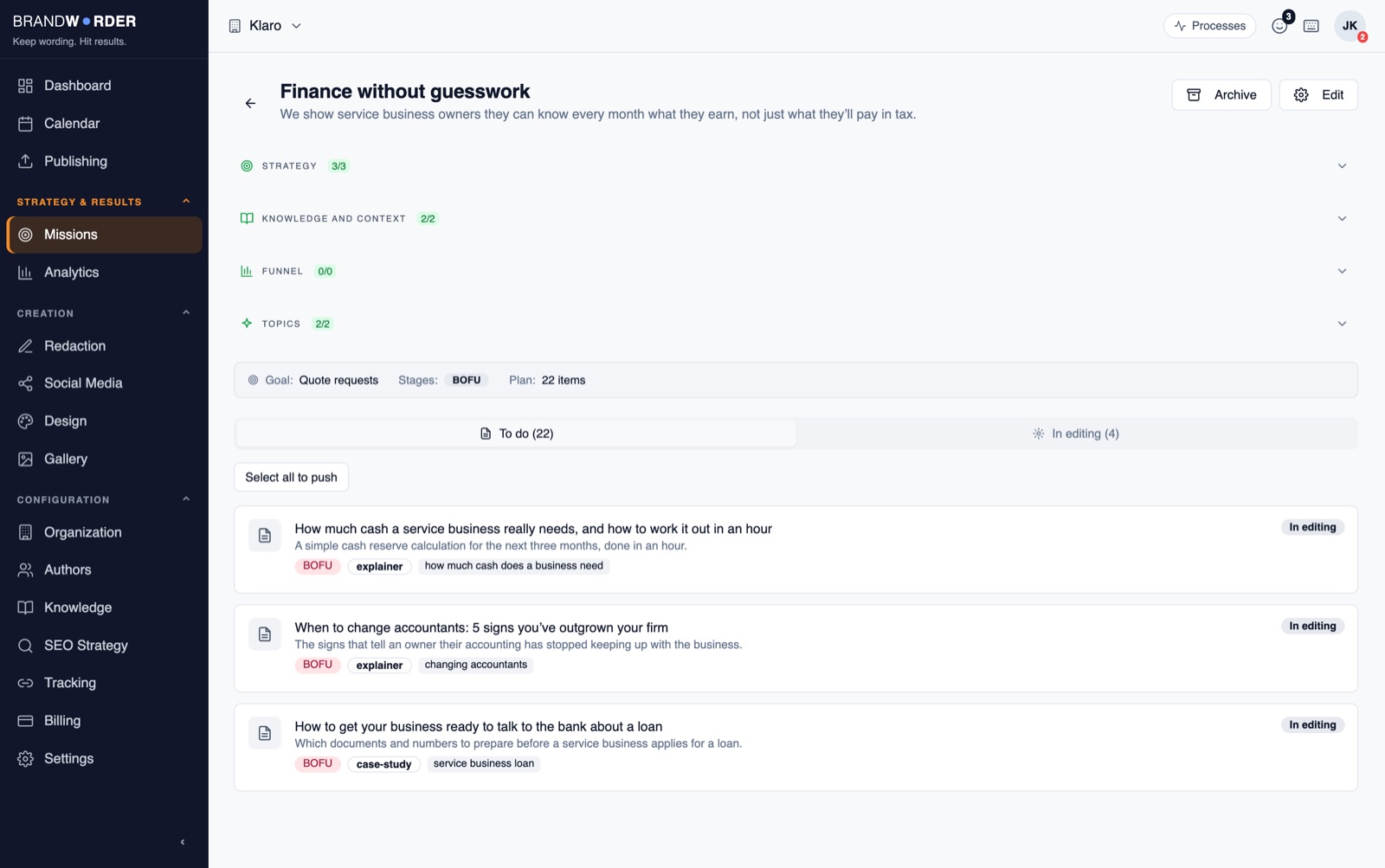
Campaign context (Business plan): the topic comes from the “Finance without guesswork” campaign. Campaign goal: quote requests. Stage: bottom of the funnel. The campaign plan has 22 topics, four of them already in the article workflow.
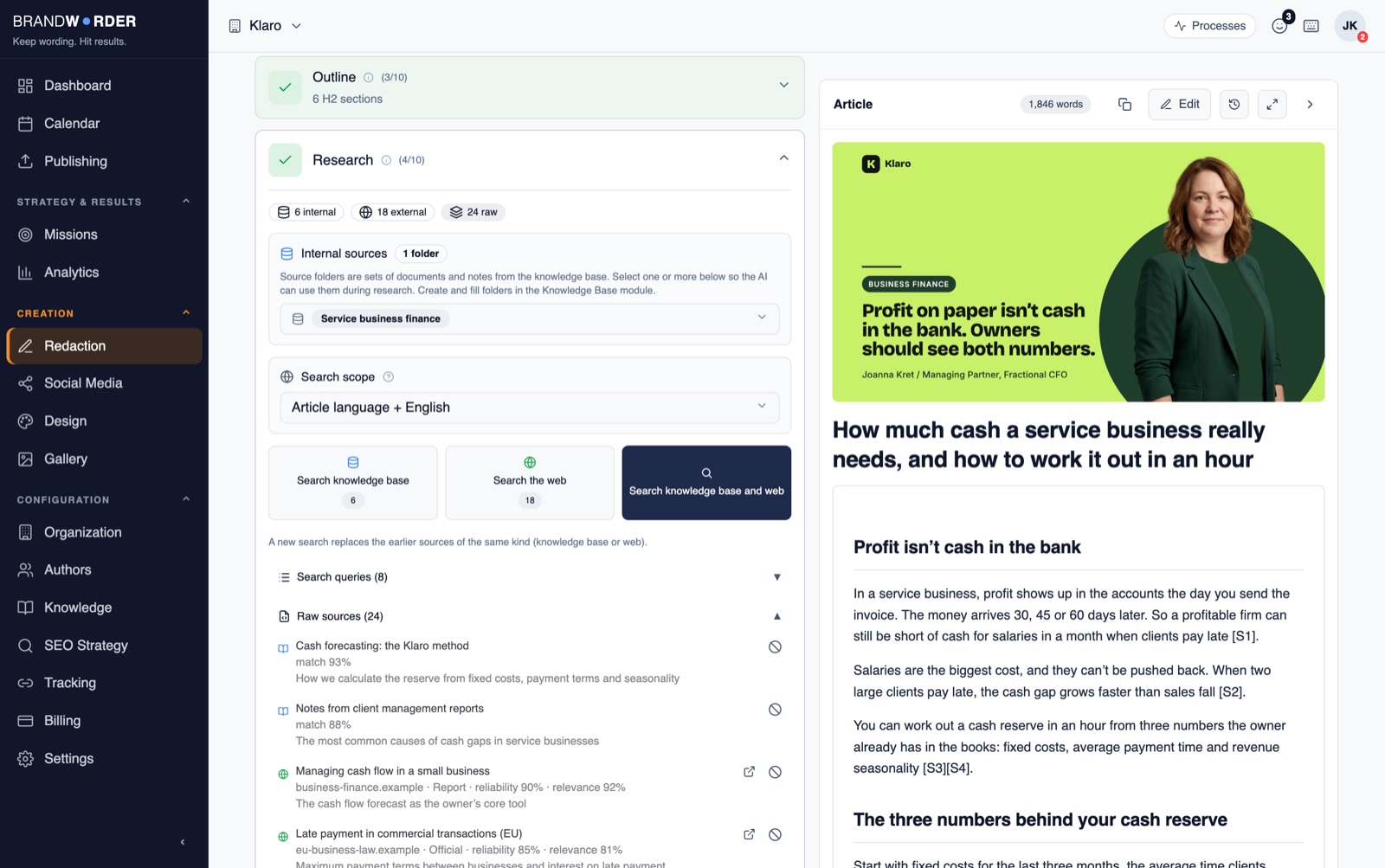
You see what the article is built on. And how the system rated each source.
- The article was pointed at a knowledge base folder on service business finance.
- The system found 24 sources: 6 in the company’s knowledge base and 18 on the web.
- Knowledge base sources get a match score: “Cash forecasting: the Klaro method” scores 93%, for example.
- Web sources are scored for reliability and relevance. One report, for example: reliability 90%, relevance 92%.
- A source you don’t trust is excluded in one click.
- The synthesis cites 8 sources.
6 from the company base, 18 from the web 8 cited
in the synthesis
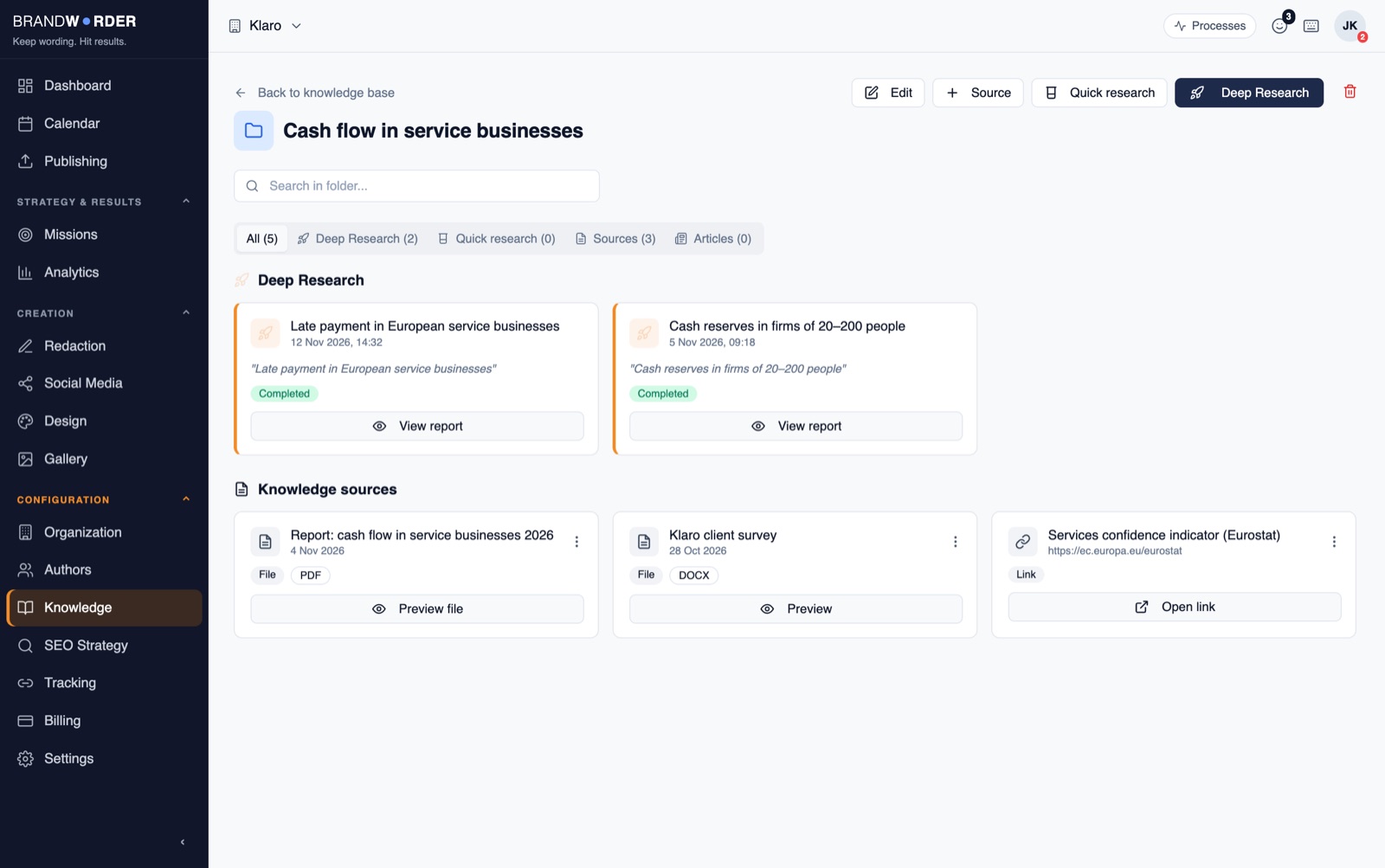
Where the company knowledge comes from: the knowledge base holds two research reports the system ran on its own (“Late payment in European service businesses” and “Cash reserves in firms of 20–200 people”), plus the company’s own materials: a cash flow report, a client survey and a link to Eurostat data.
This article’s fact report. Including what the system disputed.
The system pulled 16 claims out of the text. The screen shows work in progress: 11 resolved, 5 waiting for a human decision.
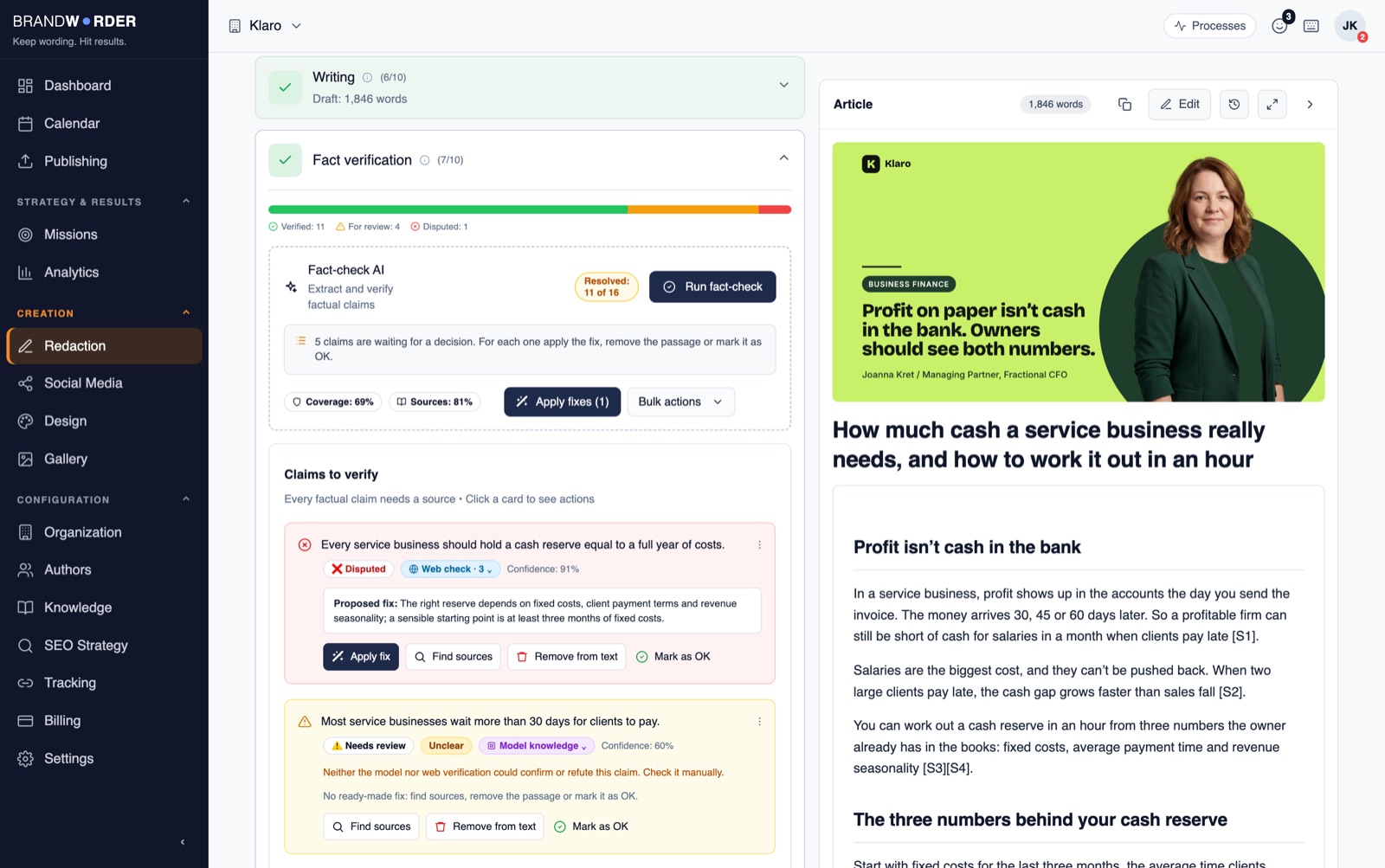
- Result bar: green verified, amber for review, red disputed.
- A disputed claim, with a fix you can apply in one click.
- A claim the system couldn’t confirm: it leaves the decision to a human.
Counters on screen: verified 11 · for review 4 · disputed 1.
Every service business should hold a cash reserve equal to a full year of costs.
Proposed fix: The right reserve depends on fixed costs, client payment terms and revenue seasonality; a sensible starting point is at least three months of fixed costs.
Most service businesses wait more than 30 days for clients to pay.
Neither the model nor web verification could confirm or refute this claim. Check it manually: find sources, remove the passage or mark it as OK.
The system disputed a sweeping generalisation and proposed a fix. It handed the claim it couldn’t confirm to a human.
The system checks the claims it has extracted. We don’t promise it will catch every one. Your expert has the final say.
Written in one specific person’s voice. Compare for yourself.
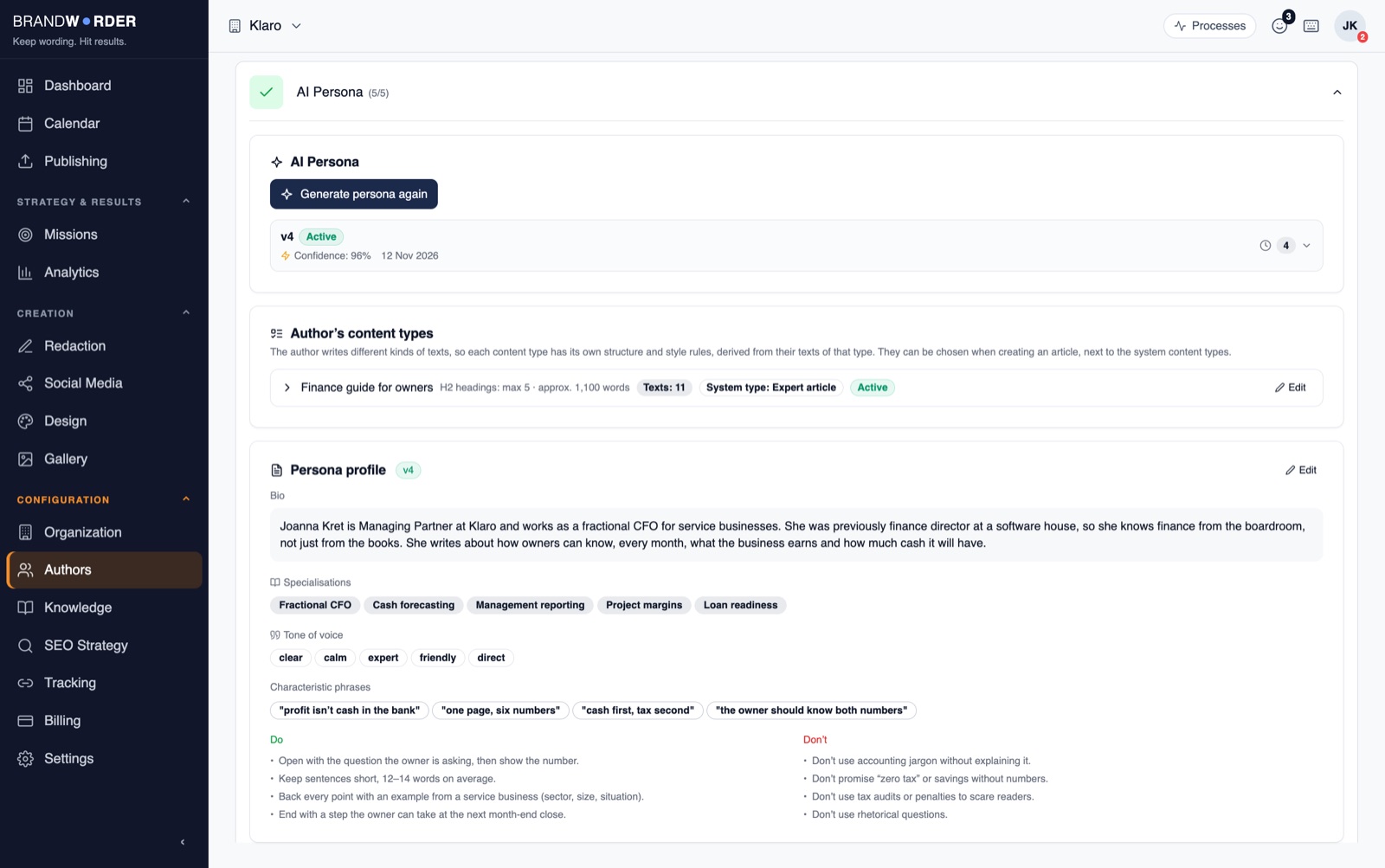
- Bio: Managing Partner at Klaro and fractional CFO for service businesses; previously finance director at a software house.
- Tone: clear, calm, expert, friendly, direct.
- Characteristic phrases, such as “profit isn’t cash in the bank” and “cash first, tax second”.
- Do: open with the question the owner is asking, then show the number. Keep sentences short.
- Don’t: promise “zero tax”, scare readers with tax audits or use rhetorical questions.
Compare with the article The article opens by saying a profitable business can still be short of cash for salaries. That idea comes straight from the expert’s profile: “profit isn’t cash in the bank”.
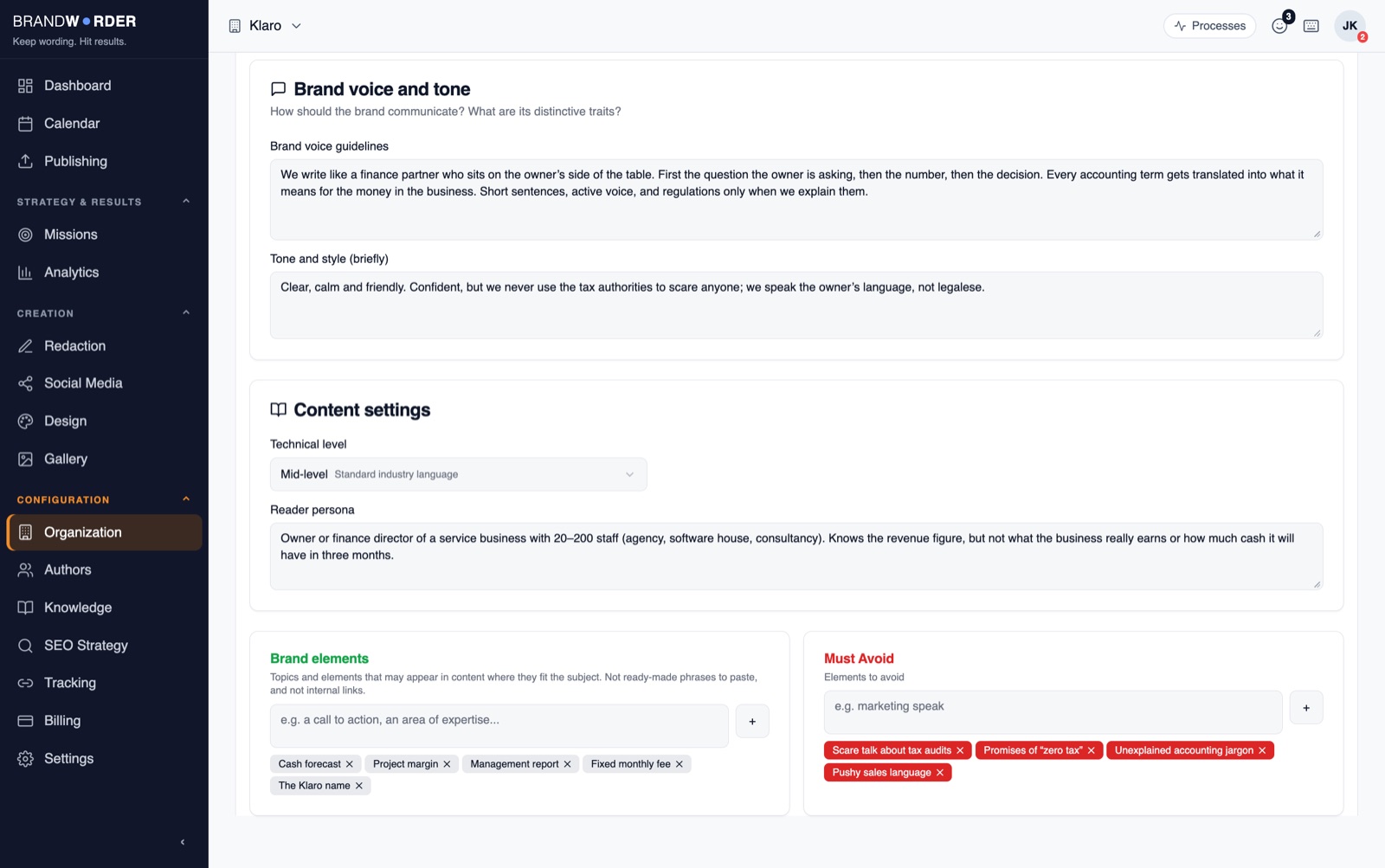
Brand Voice: “We write like a finance partner who sits on the owner’s side of the table. First the question the owner is asking, then the number, then the decision.” On the list of things to avoid: scare talk about tax audits and promises of “zero tax”. The profile describes a style; it doesn’t copy the person. The expert can edit it, and she reads every article before it’s published.
Graphics in the brand colours. With the expert’s face and a quote from the article.
- The article’s hero image and a social graphic, both from the same article.
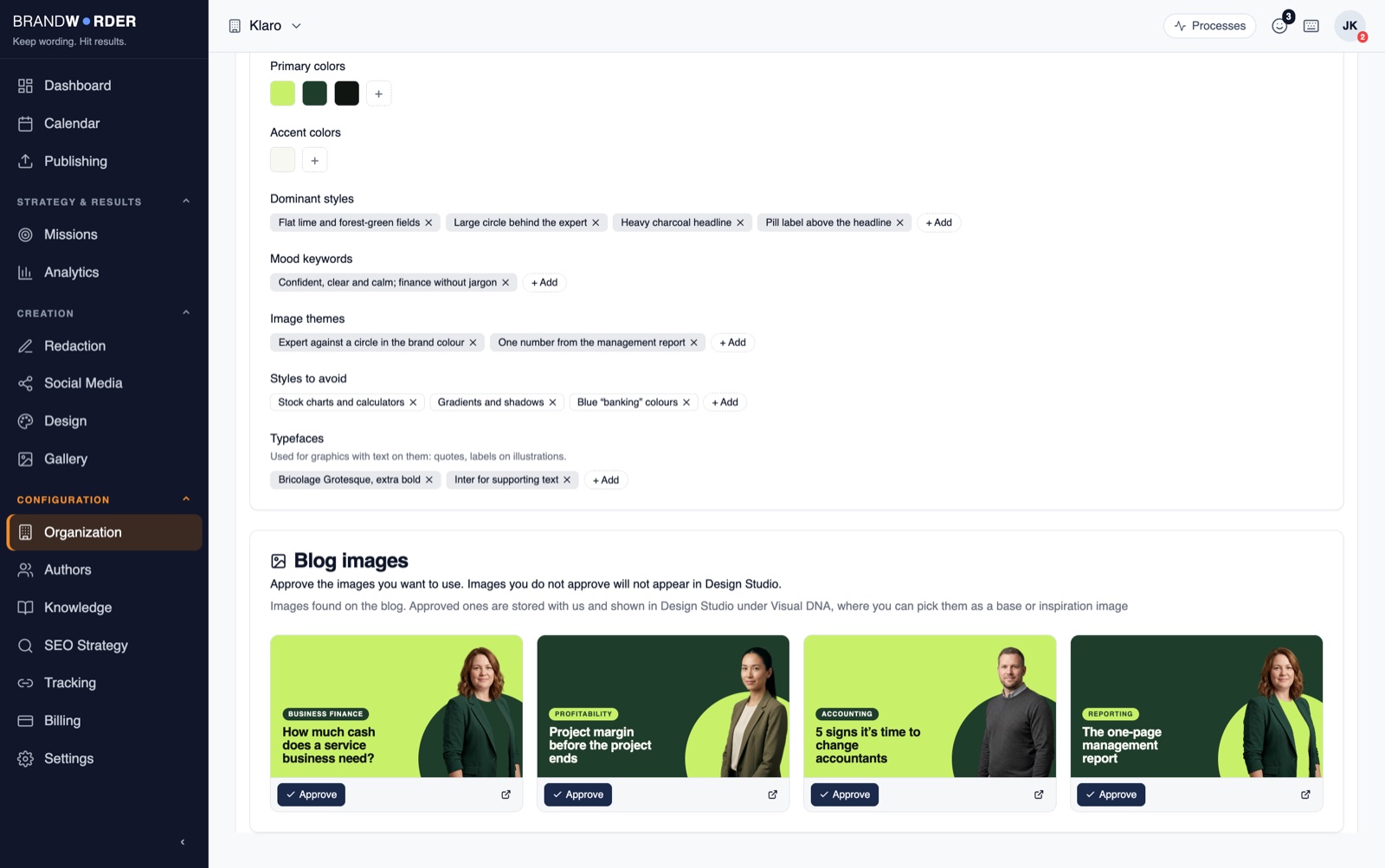
- Style: flat lime and forest-green fields, with a large circle behind the expert. It comes from Visual DNA, read from 38 images on the company blog, 12 of them approved.
- The styles the brand avoids are written down: stock charts and calculators, gradients and shadows, blue “banking” colours.
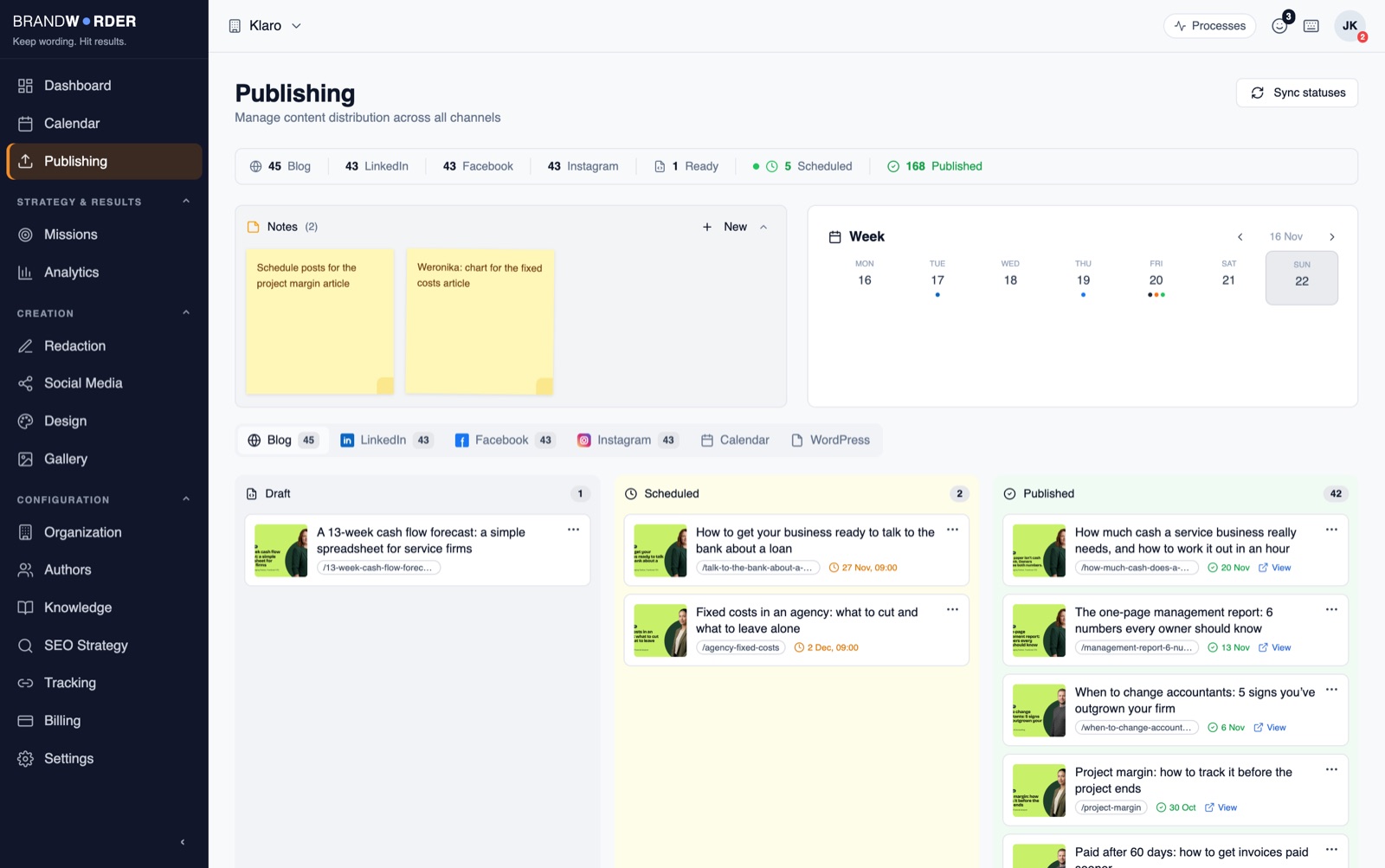
The article became a set of posts. A human approved every one.
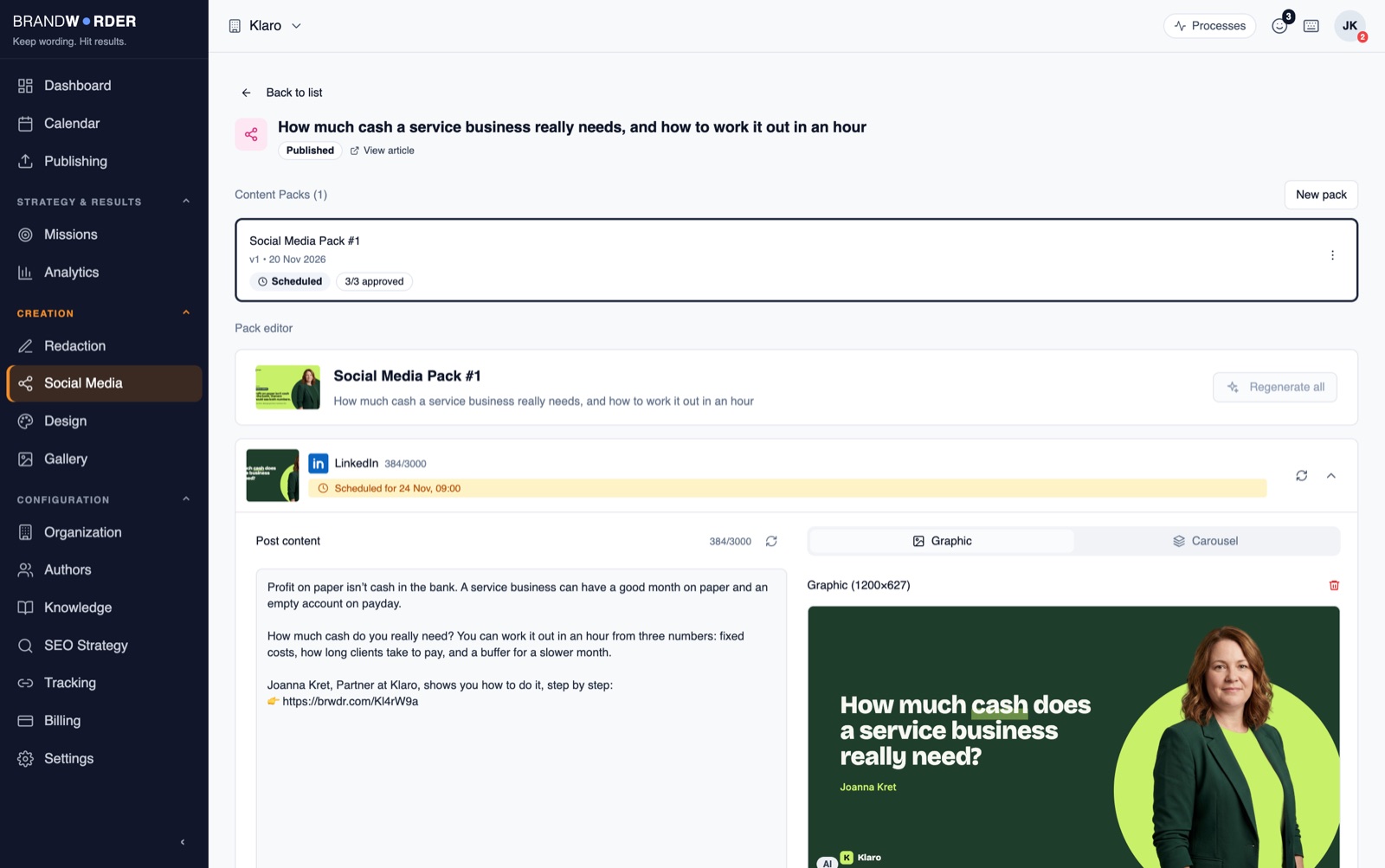
- Three posts: LinkedIn, Facebook and Instagram. All three approved.
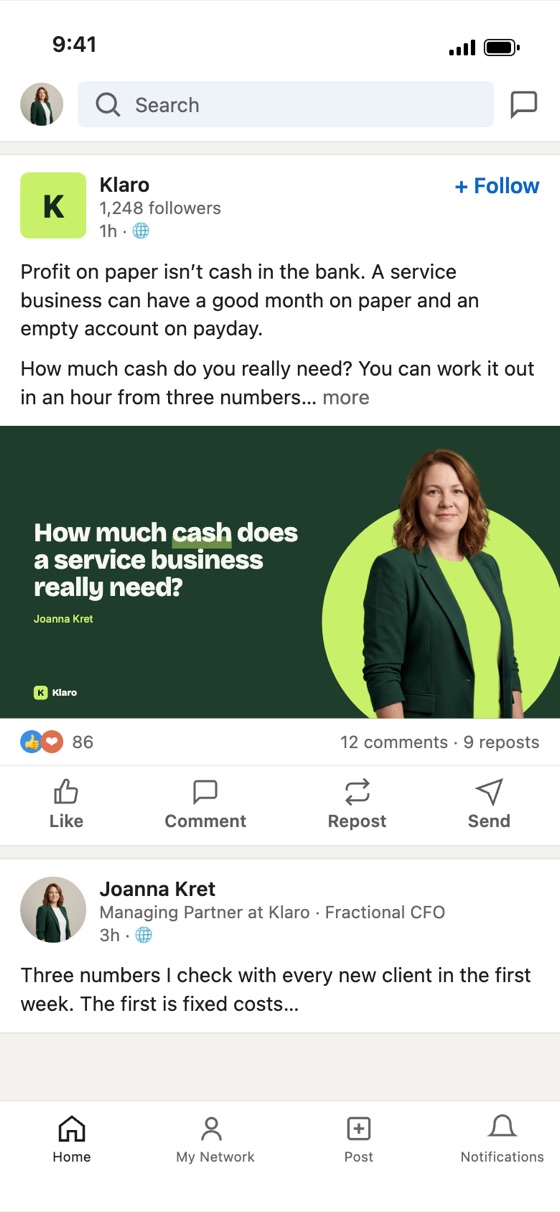
- The LinkedIn post opens with: “Profit on paper isn’t cash in the bank.” It’s scheduled for 24 November at 09:00.
- The post carries a short link to the article on the company blog.
- The post graphic comes from Design Studio. You can pick another saved graphic or upload your own.
This example shows the process. It doesn’t show results.
- Klaro is a fictional demo company. The company, the expert, the figures in the article and the sources were all made up for this demo.
- The app views are recreated with that data. They show what the screens look like, not a record of a real client’s work.
- The example tells you nothing about how much traffic, how many enquiries or how many sales an article will bring.
- On your topic the result will be different, because it depends on your company’s knowledge and on your expert.